Home
Home Articles
 Twos Talks
 Videos
The Doctor Who Pioneered Modern Infographic Design
The story of Fritz Kahn, who used visual systems to explain the human body, pioneered modern infographic design, and continued to influence design after fleeing Nazi Germany.
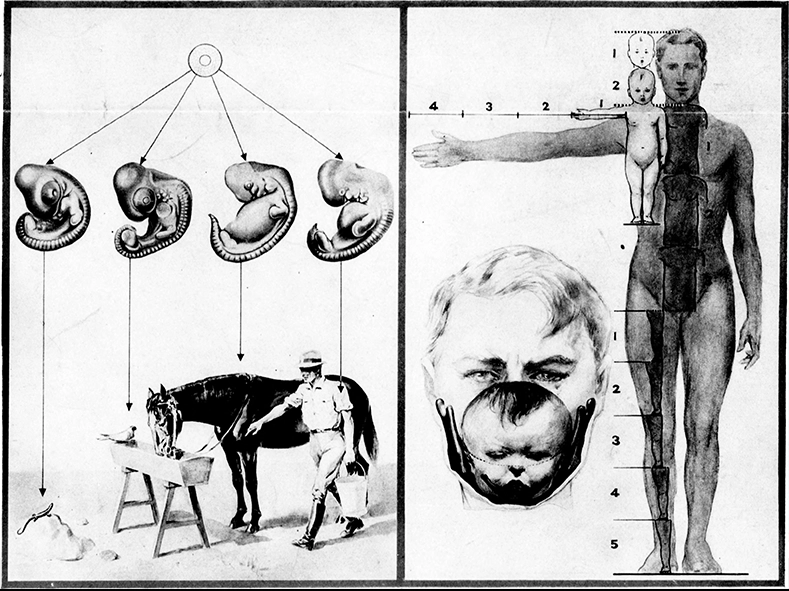
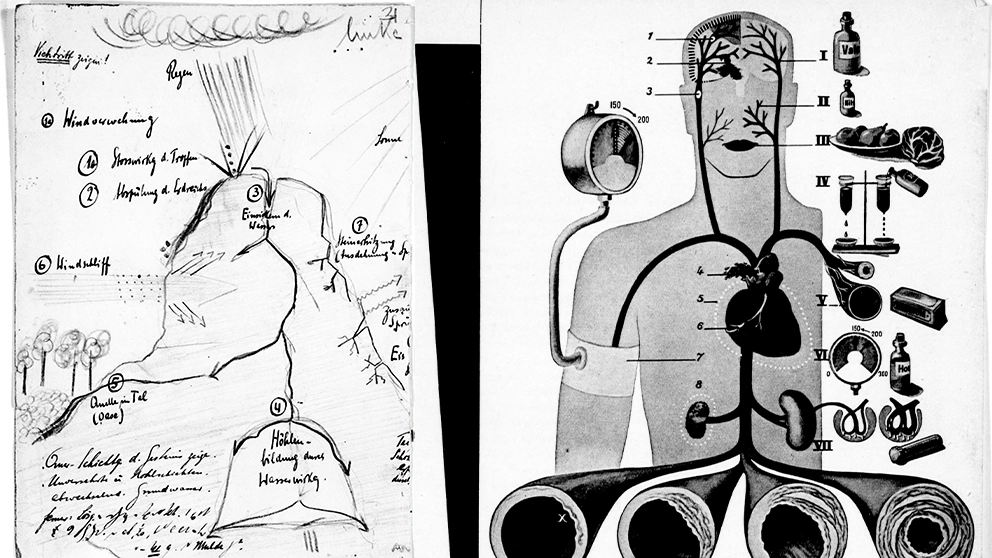
At the beginning of the 20th century, long before the term “infographic” existed, a German doctor found a new way to explain science. Fritz Kahn believed that knowledge should be seen, not only read. Through collaboration with artists, architects, and designers, he turned the invisible processes of the human body into visual systems that felt modern, mechanical, and deeply tied to the industrial age. His work would influence how science, medicine, and design communicate to this day.
A Doctor with a Visual Mind
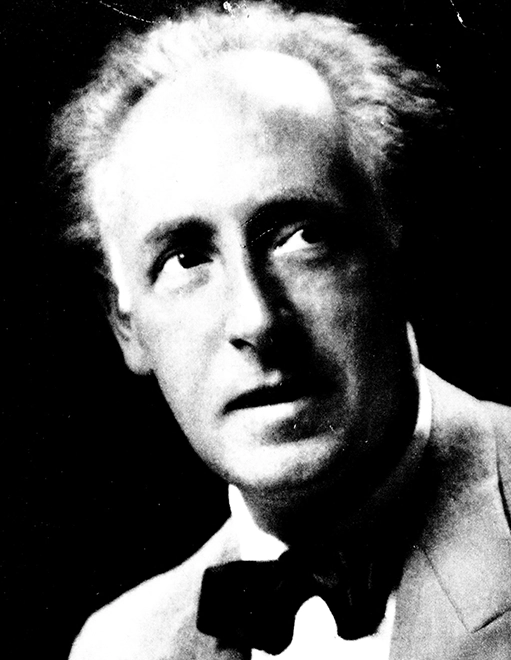
Fritz Kahn was born in 1888 and trained as a physician in Germany. By the 1910s, he was based in Berlin, working as a gynecologist while also writing for popular science publications. Unlike most medical writers of his time, Kahn was not satisfied with dense text or technical diagrams. He wanted to capture attention and make complex biological processes immediately understandable to a broad audience.
Kahn recognized that the modern reader lived in a world dominated by factories, machines, and urban systems. He decided to explain the human body by using the same visual system.
Turning Science into Design
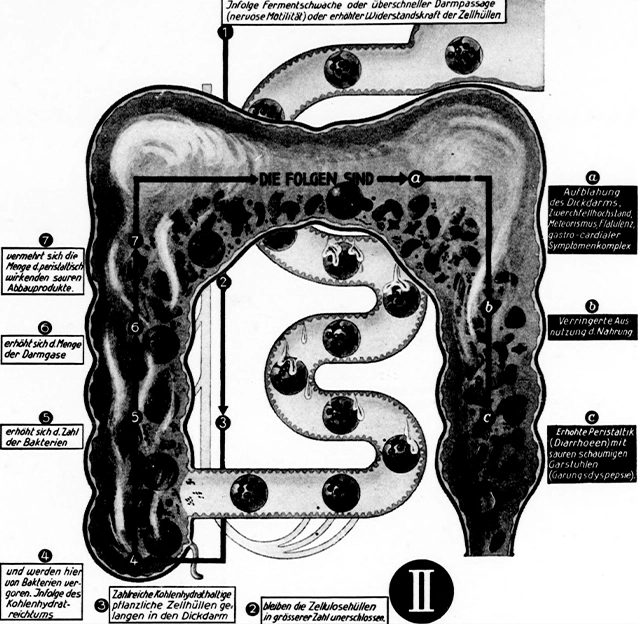
Rather than illustrating his books himself, Kahn acted as a creative director. He hired painters, architects, and graphic designers and provided them with detailed conceptual instructions. Each collaborator interpreted his ideas through their own visual style, resulting in images that were both scientifically informed and visually striking.
This collaborative method was unusual for scientific publishing at the time. It allowed Kahn’s work to sit somewhere between medical education, visual art, and early information design.
“Man as Industrial Palace”
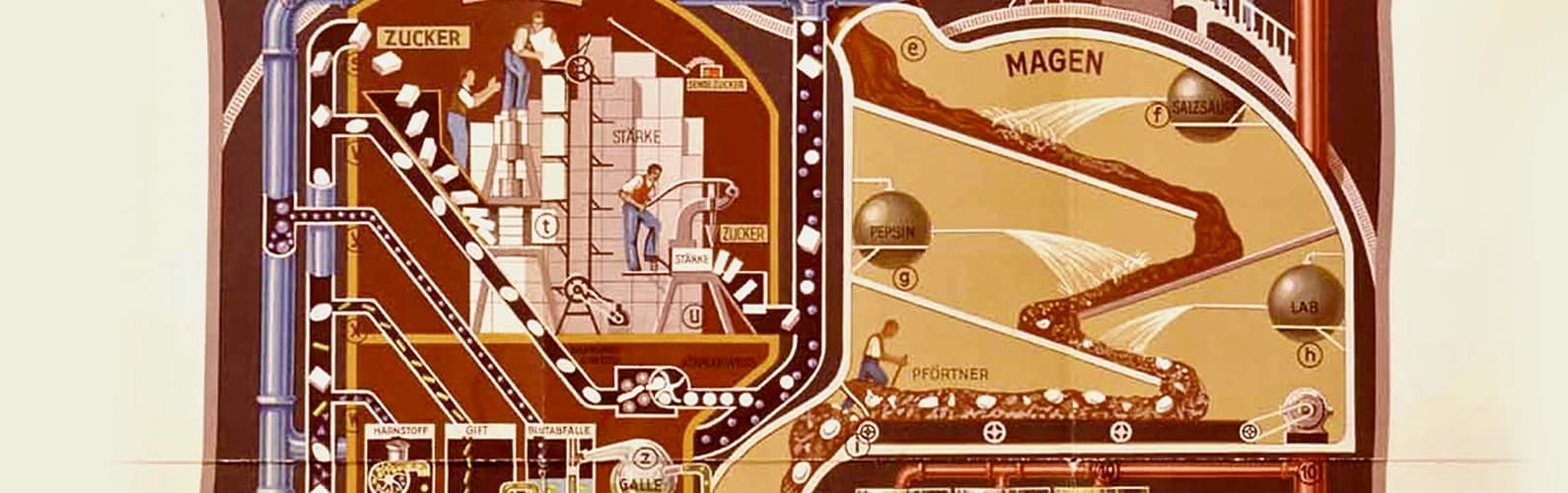
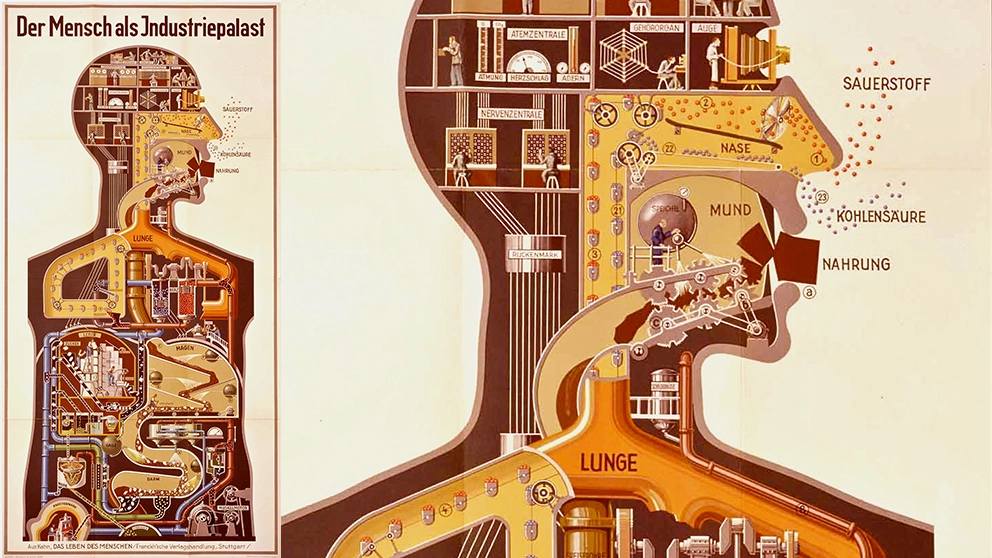
In 1926, Kahn published his most famous work, a poster titled Man as Industrial Palace. The illustration depicts the human body as a vast factory operated by tiny workers. The lungs function like mechanical bellows, the stomach becomes a rock-sorting plant, the throat operates as a system of gears, and the brain appears as a switchboard filled with control panels.
The image reflected both fascination and anxiety about industrialization in Western life. By framing the body as a machine, Kahn offered a metaphor that felt immediately familiar to a modern audience. The poster became one of the most iconic scientific illustrations of the early 20th century and a landmark in the history of infographic design.
Banned, Burned, and Forced to Flee
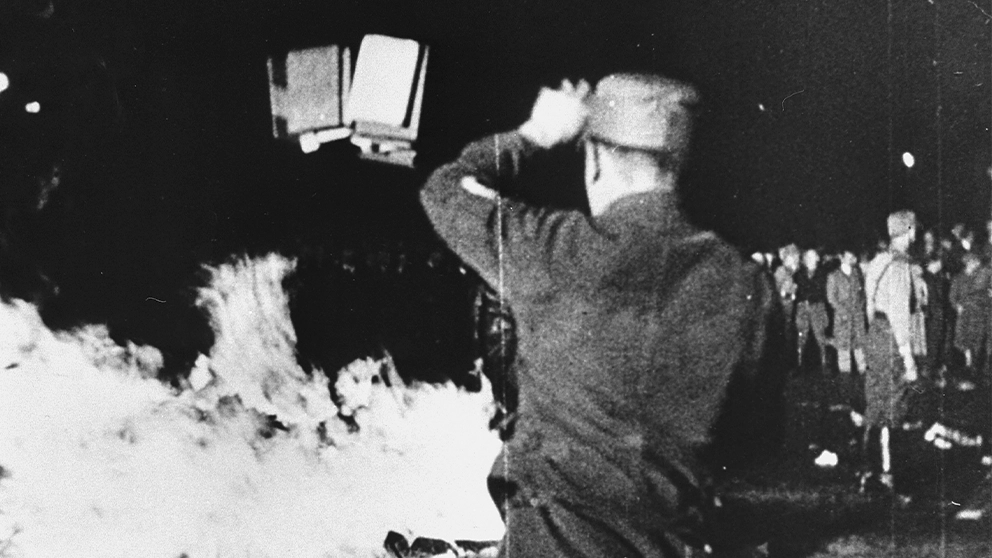
When the Nazis rose to power, Kahn’s success turned into danger. As a Jewish intellectual, his books were banned and publicly burned. His work was erased from German cultural life almost overnight.
Kahn left Germany, first immigrating to Palestine. Later, with the help of his friend Albert Einstein, he moved to the United States. Despite exile and displacement, he continued writing and publishing scientific books, carrying his visual philosophy into a new cultural context.
The Body of Influence
Fritz Kahn changed how people visualized complex scientific systems, especially the human body. His work anticipated modern infographics, data visualization, and systems thinking by decades. Today, designers and educators continue to draw inspiration from his ability to make intricate processes understandable.
Kahn’s legacy is not only one of innovation, but of resilience. His ideas endured censorship, borders, and history itself, lasting because they were meant to be seen.