Home
Home Articles
 Twos Talks
 Videos
First Things First: The First Graphic Designer in History
A short essay exploring how graphic design existed long before W.A. Dwiggins coined the term “graphic designer.”

Graphic design is so ordinary today that it almost slips past us. The subway map you follow, the book you pick up because its cover feels right, the concert poster you notice from across the street, each one reflects choices someone made about contrast, rhythm, typography, proportion and sequence. Someone decided how your eye would travel and how you would take in the message.
The strange part is that the word for the person who does it is relatively new. The profession belongs to the modern world, yet the work itself has been with us for a very long time. People have been arranging words and images with intention far earlier than any shared vocabulary existed to describe what they were doing.
And that leads to the central question of this essay: If humans have been designing visual communication for thousands of years, who can we honestly call the first graphic designer?

Before the Profession Had a Word
Human communication has always been visual. Early cave paintings in Lascaux and Chauvet show more than animals on a wall. Each figure sits in a chosen place, arranged with an eye for empty space and movement. Sumerian clay tablets from around 3000 BCE show rows of signs placed with care, with margins that stay even and symbols adjusted to the task at hand.
Egyptian papyrus scrolls mix writing and image in a way that guides a reader through a story. Medieval manuscripts add decorated initials, notes in the margins and page plans that feel surprisingly familiar to a modern designer. The Lindisfarne Gospels (around 700 CE) and the Book of Kells (around 800 CE) move even further in this direction and turn the page into a field of texture, ornament, letterform and image.
None of the people behind these works were “graphic designers.” They were scribes, illustrators, illuminators, artisans, monks, clerks, each tied to a craft rather than a profession. Their work contained design, but their world lacked a word that unified these acts under a single identity.
The practice existed, but the profession did not.
Printers or Designers?
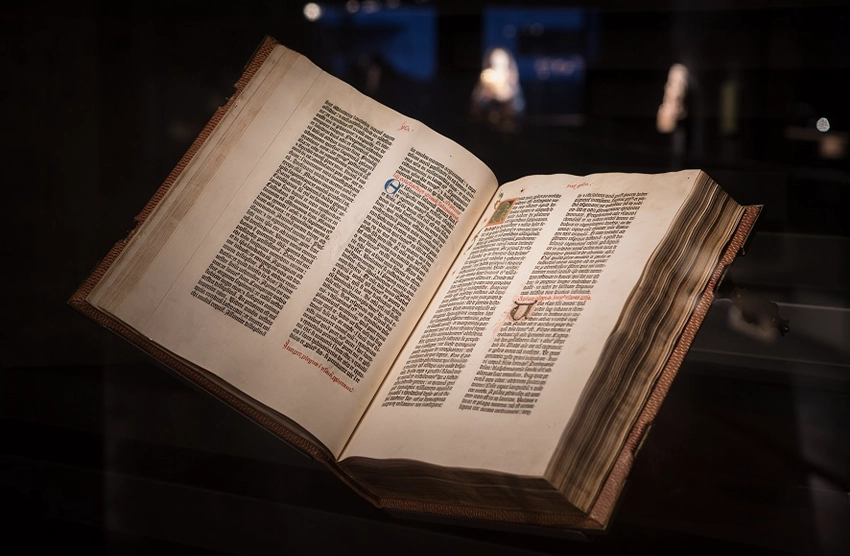
The arrival of the printing press in the mid-15th century exploded the need for visual organization. Every book required choices: type size, column width, margins, running heads, spacing, decorative initials, consistency across hundreds of pages. And the workshop that produced the first Gutenberg Bible (circa 1455) had to solve all of these.
If you examine a Gutenberg spread today, its logic feels familiar. Two balanced columns. A predictable rhythm of blackletter textura. An invisible grid implied by the even blocks of text. Later, rubricators added red initials to help navigation, an early form of typographic guidance.
In other words, a complete design system existed. But its creators were called printers. That word, in the centuries that followed, meant far more than it does today. A printer was a compositor, typographer, editor, production manager, sometimes even illustrator. By the 18th and 19th centuries, printers like John Baskerville and Giambattista Bodoni produced work that we would instantly classify as design-driven, carefully selected proportions, clear typographic palettes, and deliberate spatial reasoning.
Too Many Names
By the early twentieth century, industrialization and mass media changed the pace and volume of visual communication. Posters covered European boulevards. Advertisements filled American magazines. Packaging, trademarks, and illustrated catalogs needed people who could blend aesthetics with persuasion.
But the vocabulary lagged behind the work. You might be:
• an illustrator
• a commercial artist
• an affichiste
• a layout person
• a book designer
• a lettering artist
• an advertising designer
Each title described one corner of the field, never the whole. The result was a scattered identity. Without a shared name, the profession struggled to explain itself, to set expectations, or to teach newcomers what the job actually involved.

The Day “Graphic Designer” Appeared
The turning point arrived on August 29, 1922. William Addison Dwiggins, an American designer whose practice included illustration, calligraphy, type design, advertising layouts, and especially book design, published an article in The Boston Evening Transcript. In it, he used a phrase that had never appeared in print before:
“Graphic Designer.”
It was, by most accounts, a practical invention. Dwiggins needed a term that described the range of his work. None of the existing titles fit. Illustrator was too narrow. Advertising designer sounded tied to commerce. Book designer ignored much of what he produced. Lettering artist captured only a small part of his visual thinking.
So, he introduced a new name. The phrase helped explain the kind of work he was doing, work that moved across illustration, typography, layout, and printed communication.
The term spread slowly but steadily. Through the 1930s and 1940s, studios began adopting it. Design schools added it to course descriptions. Publications used it for practitioners whose work moved between layout, typography, image-making, and visual systems. By mid-century, “graphic designer” had become the shared language of a once fragmented field.
So Who Was the First Graphic Designer?
The answer depends on what we mean by “first.” If we look at practice, the lineage reaches back to the earliest communicative marks. Scribes, printers, illuminators, illustrators, engravers, typographers, and calligraphers all contributed to what would later be recognized as graphic design.
If we look at profession, the answer becomes more precise. The first person to call himself a graphic designer, and to present the work as a single discipline, was W.A. Dwiggins in 1922. He did not invent the work itself. He gave it a name.
That name made a difference. With a shared title, the field could be taught, organized, discussed, and expanded. Designers could recognize one another. The outlines of the profession became visible, and therefore open to change.
Graphic design existed long before it understood itself. Its “first” practitioner was not the earliest maker, but the one who helped the field see itself as a whole.