Home
Home Articles
 Twos Talks
 Videos
First Things First: The First Film Poster in History
A short essay exploring the origins of the first film poster in history and how cinema first stepped onto the street.
Before cinema was an art, it was a miracle. In the final years of the nineteenth century, people went to the movies to witness a machine that could command time. Stories and stars were secondary to the spectacle of the Cinématographe. Because the technology itself was the attraction, the earliest advertisements were not for individual films but for the event of the screening. They were notices for a scientific wonder, similar to a circus bill or a fairground announcement.
Yet, as the novelty of moving shadows began to settle into a medium of storytelling, cinema needed something more. It needed a way to tell the public what they would see before the lights went down. It needed its first public face.
Before the Film Poster
The world into which the film poster was born was already saturated with paper. Late Victorian cities were covered in theatre bills, circus lithographs, and announcements for magic lantern shows. These were the ancestors of the film poster, but they functioned differently. A theatre poster sold a play meant to be performed live over many weeks. A magic lantern notice promoted a sequence of hand-painted slides.
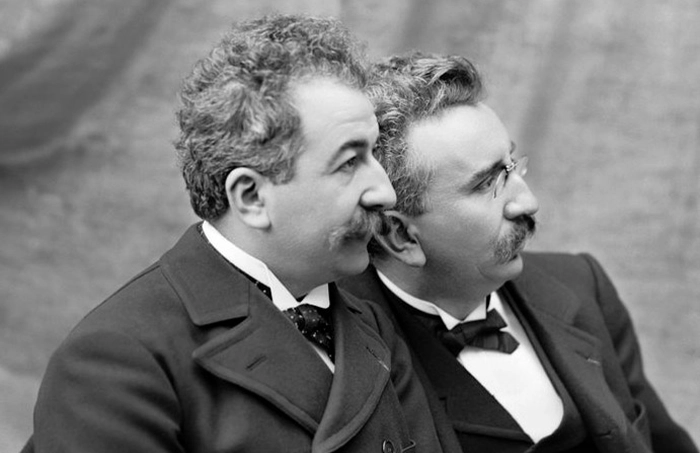
The earliest advertisements for the Lumière brothers’ screenings followed the same logic. They were often text-heavy notices or generic illustrations showing an audience gathered around a screen. The focus was on the venue, such as the Grand Café or the Salon Indien, and on the Cinématographe as an invention. At this stage, individual films were rarely treated as distinct works. Short clips of trains, workers, or daily life appeared as items on a program rather than subjects of promotion in their own right.
A Medium Looking for Its Public
In the first few months after the famous December 1895 screening in Paris, the identity of cinema was still fluid. The advertising reflected this. Most posters focused on the apparatus. They showed a crowd of well-dressed Parisians reacting in awe to a screen. The image was about the experience of watching, not the content of what was being watched.
This was cinema as a “novelty attraction.” In this context, the idea of promoting a single film would have seemed almost unnecessary. Why advertise one short clip of a garden when the real draw was the fact that the garden moved at all? However, as the Lumière brothers began to produce more varied content, one particular film stood out, requiring its own visual summary.
The First Named Film Poster
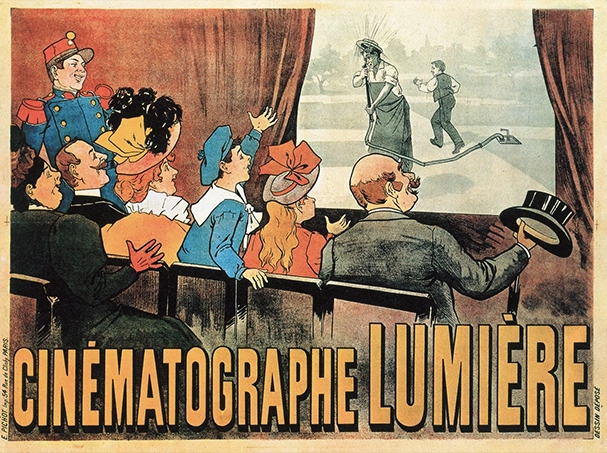
The image widely cited as the earliest known poster tied to a specific film is the advertisement for L’Arroseur arrosé (The Waterer Watered). The poster is usually dated to late 1895 or early 1896 and is attributed to the illustrator Marcellin Auzolle. It is a landmark because it introduces a subtle shift in emphasis. The focus moves away from the audience in the theatre and toward the action on the screen.
The poster depicts a scene from the film, a boy stepping on a hose to trick a gardener and then releasing it so the man is drenched with water. It is essentially a lithograph of a gag. The word “Cinématographe” still appears prominently, yet the visual emphasis has changed. For the first time, a single narrative moment is used to sell the experience of a specific film.
Historians usually describe this example with careful language. Many refer to it as the “first,” but the claim is better understood as the earliest surviving or recorded poster designed around the content of a single title. It marks the moment when the film poster began to move away from advertising a machine and toward presenting a story.
Selling the Scene
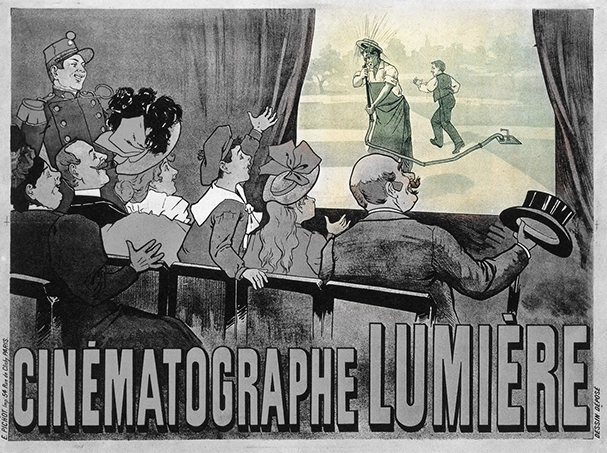
This transition is significant because it marks the birth of film branding. By using an illustration of the gardener and the boy, the poster created a static identity for a moving medium. This leads to a central insight: the film poster did not begin with a title or a star, but with a “scene.”
In the early days, cinema could not yet sell its actors, who were anonymous, or its directors. It could only sell a moment of relatable action. The L’Arroseur arrosé poster proved that a single frozen image could summarize the energy of a moving sequence. It was the first attempt to give a permanent face to a fleeting experience.
Furthermore, this poster marked the transition of cinema from a technological curiosity to a cultural product. When the poster focused on the machine, cinema was for engineers and thrill-seekers. When the poster focused on the gardener being splashed, cinema became for everyone. It was the moment the “show” became a “movie.”
So What Was the First Film Poster?
The search for a singular “first” in cinema history rarely leads to a single, uncontested object. Earlier advertisements for the Cinématographe existed, and many handbills functioned as posters in practice. Yet if the film poster is understood as a designed image that gives a specific film a recognizable identity, the advertisement for L’Arroseur arrosé remains the clearest starting point.
With a simple lithograph of a garden prank, the poster introduced a powerful idea: a film could be represented by a single image. In doing so, it carried cinema out of the laboratory and onto the walls of the city, where anyone passing by could encounter it before ever entering a theatre.