Home
 Articles
 Twos Talks
 Videos
The Most Bizarre Self-Portraits in Art History
Artists have long found inventive ways to represent themselves. These works challenge the conventions of self-portraiture and unsettle the idea of what a self-portrait can be.
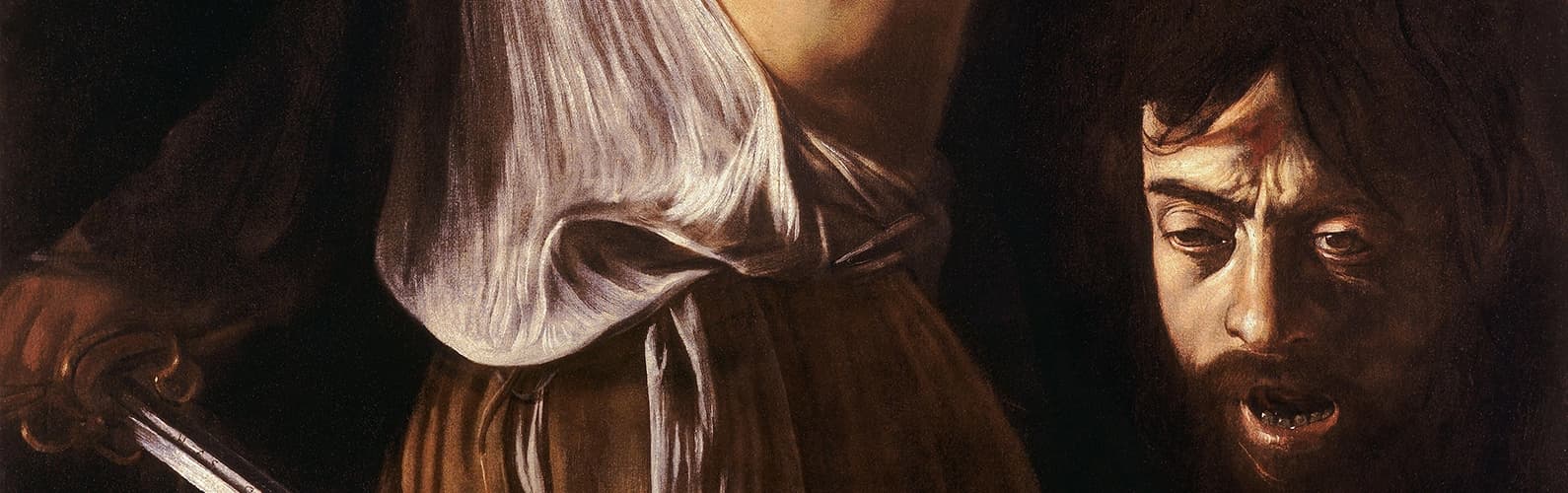
Some self-portraits hide in plain sight. Artists have slipped their likenesses among figures in larger paintings or left them as tiny reflections in polished metal. The works in this selection use less familiar strategies. An artist’s field of vision can serve as a likeness; a staged death can take the place of a conventional pose. Elsewhere, the artist appears as an object or through a symbolic figure whose identity depends on interpretation. The question running through these works is where likeness ends and interpretation begins.
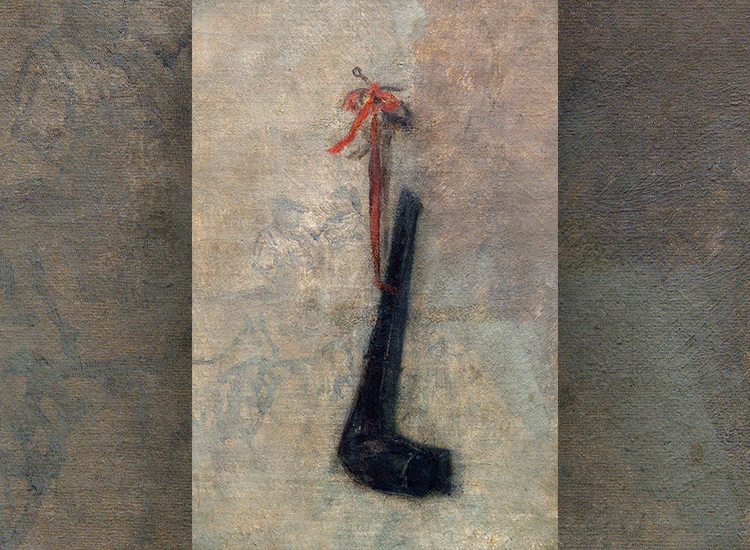
Gustave Courbet, Self-Portrait in the Shape of a Pipe (1858)
Courbet’s early self-portraits cast him in sharply different roles, from rebellious bohemian to anxious dreamer. Self-Portrait in the Shape of a Pipe takes this experimentation to an unusual extreme. The 1858 painting shows a tobacco pipe hanging against a muted wall, with a small red ribbon tied near its stem. The artist’s face is absent, and the pipe takes its place.
The Fondation Beyeler classifies the work as a trompe-l’œil still life and offers several possible readings. Courbet may have playfully stepped out of his own portrait altogether. The lone object may also poke fun at the hierarchy of genres in nineteenth-century art, which ranked still life below paintings of the human figure. The pipe itself offers another possibility. In Self-Portrait with Black Dog, Courbet holds his pipe much as a painter might hold a brush.
Courbet painted the work during a stay in Frankfurt in 1858 and left it with artist friends as a memento. The pipe served as his likeness and as a keepsake of his presence.
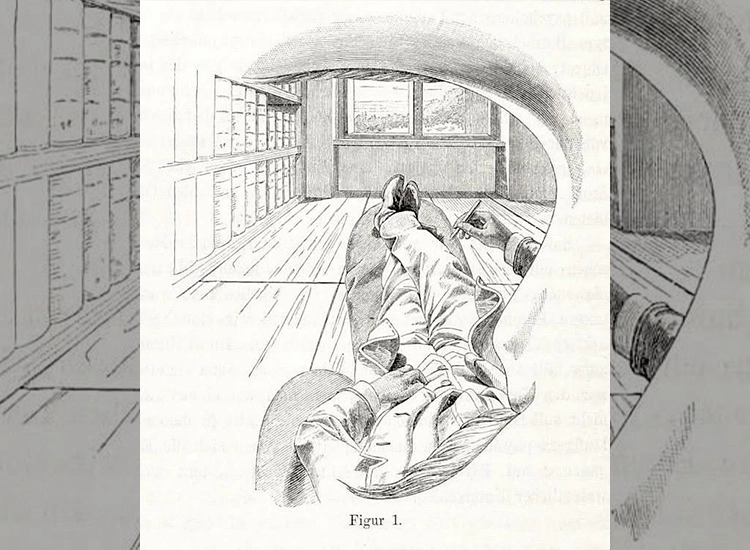
Ernst Mach, Self-Portrait (View from the Left Eye) (1886)
Close your right eye and look at Mach’s drawing. His eyebrow, nose, and mustache frame the scene. Fragments of his torso, legs, and feet appear alongside the room around him. The image places the viewer inside Mach’s field of vision.
The Austrian physicist and philosopher included the image in his 1886 book Beiträge zur Analyse der Empfindungen (Contributions to the Analysis of Sensations) as part of his inquiry into perception and the self. That viewpoint is also what makes the drawing a self-portrait: Mach’s own visual experience serves as his likeness. His right hand enters the frame with a pencil. That detail creates a curious loop. Mach appears to record the very view he inhabits, although the surface on which he draws falls outside the frame.
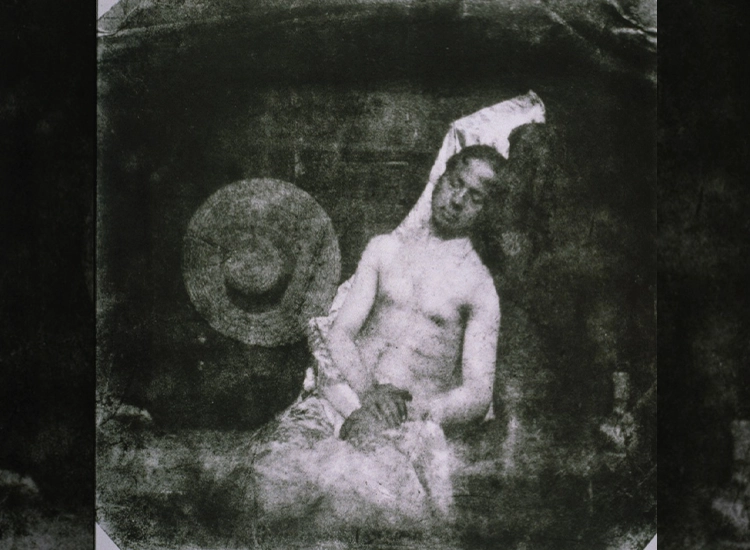
Hippolyte Bayard, Le Noyé (The Drowned Man) (1840)
In October 1840, Hippolyte Bayard, one of photography’s early innovators, staged his own death. In the photograph, he reclines with closed eyes and a lifeless-looking body, as if pulled from the water. The performance continues on the back of an inscribed print, where Bayard wrote a mock obituary in his own name. The text accuses the French government of favoring Louis Daguerre, a fellow photographic pioneer whose process had received official support, and of denying comparable backing to Bayard’s own invention. The note delivers a bitter punchline: Bayard supposedly drowned in despair, and no one came to claim his body.
The image belongs to the early history of staged photography, and its audacity lies in the way it exploits the medium’s claim to truth. The photograph appears to document a death. The writing on its reverse exposes the scene as a fiction and frames the self-portrait as a pointed protest over who gets credit for a new invention.
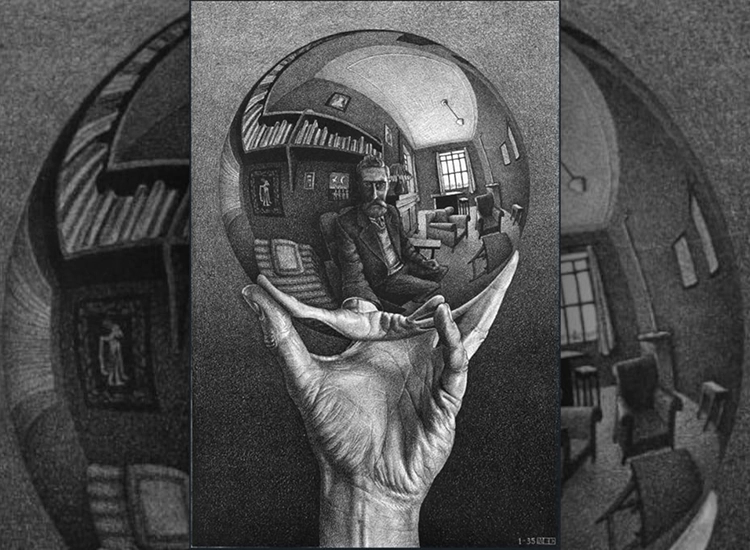
M. C. Escher, Hand with Reflecting Sphere (Self-Portrait in Spherical Mirror) (1935)
The hand in the foreground seems almost to belong to the viewer. Inside the mirrored sphere, Escher sits in his Rome studio and looks straight out at us. The convex surface distorts the room around him. Objects close to the sphere appear enlarged. Those farther away shrink.
Dutch graphic artist M. C. Escher made the lithograph in January 1935, when he lived at Via Alessandro Poerio 122 in Rome. He often used spherical mirrors for self-portraits, which let him study his own appearance and the surrounding space in a single view. The printing process adds a small optical puzzle of its own. Lithography reverses the image, so the hand that appears to be his left is actually his right. The hand anchors the sphere in the foreground. Escher’s likeness and the room occupy the same distorted field of vision.
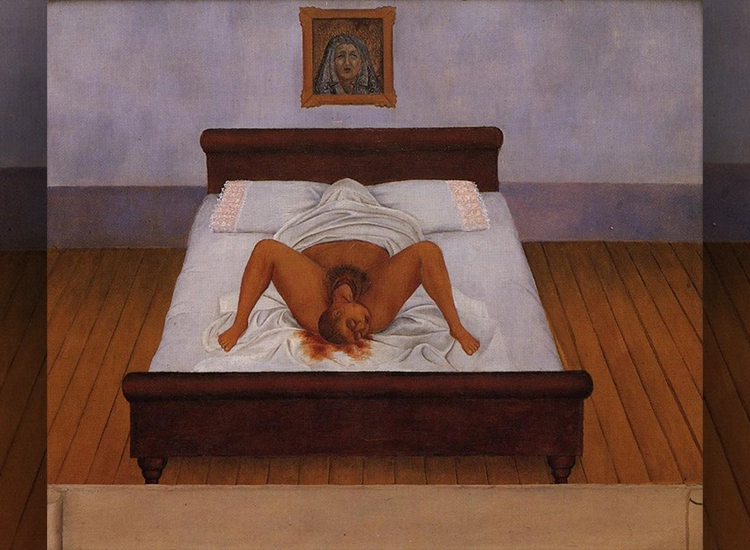
Frida Kahlo, Mi nacimiento (My Birth) (1932)
A newborn with Kahlo’s distinctive joined eyebrows emerges from a woman whose head is covered by a white sheet. Above the bed hangs an image of the Virgin of Sorrows. An empty scroll below the bed recalls the inscriptions on Mexican ex-voto paintings, which record a danger survived or give thanks for divine aid. Kahlo leaves the scroll blank.
Mexican painter Frida Kahlo described the painting as her imagined birth. She made it in 1932, the year her mother died and she suffered a miscarriage in Detroit. Those events invite biographical readings, though neither alone explains the work. The infant’s features identify her as Kahlo herself, making the painting an imagined self-portrait of a moment she could never remember.
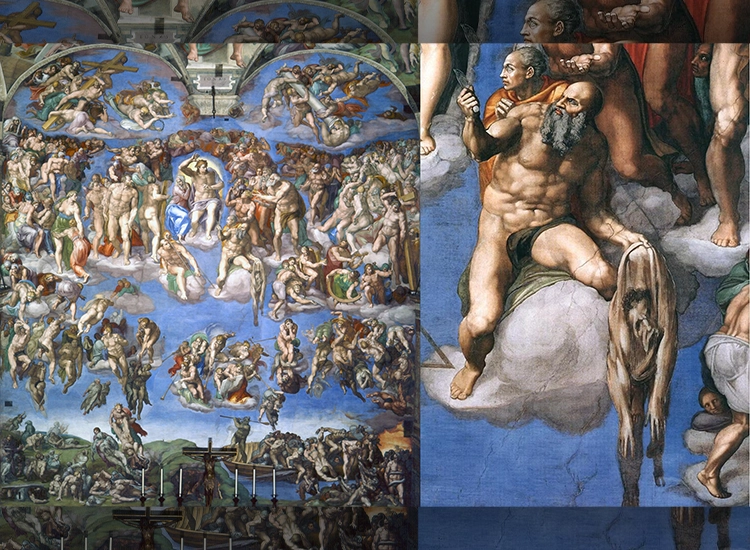
Michelangelo, The Last Judgment (1536–1541)
In Michelangelo’s The Last Judgment, Saint Bartholomew, one of Christ’s apostles, holds a knife in one hand and his flayed skin in the other. According to Christian tradition, Bartholomew was martyred by being skinned alive. The face on the limp skin is widely identified as Michelangelo’s own. The artist’s likeness appears on the remains of a body within a fresco devoted to resurrection and final judgment.
The image has often been interpreted as a sign of Michelangelo’s spiritual anguish or sense of unworthiness. Art historian Bernadine Barnes cautions against treating the self-portrait as direct evidence of psychological torment. Barnes points to the fresco’s wider concern with the resurrection of the physical body. In that context, the skin belongs to the work’s larger meditation on what happens to the body after death.
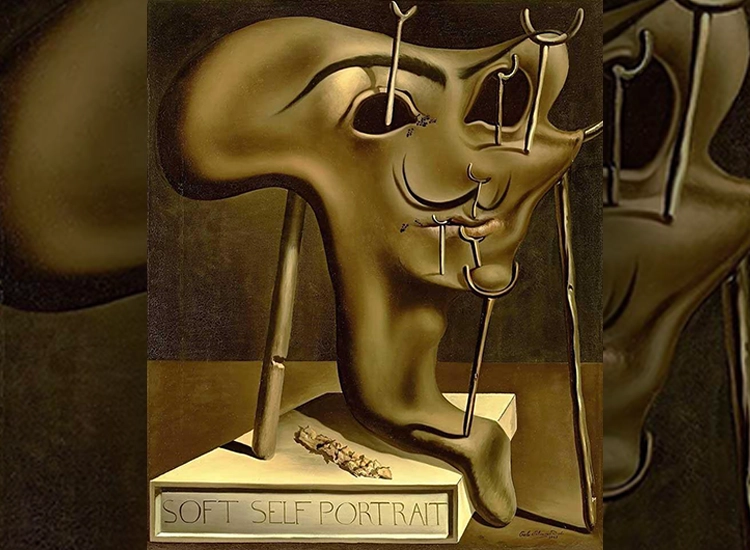
Salvador Dalí, Soft Self Portrait with Grilled Bacon (1941)
Spanish Surrealist Salvador Dalí depicts his face drooping on thin crutches; its soft features have no skull to support them. Ants crawl across the surface, and a strip of grilled bacon sits below. The image draws an unsettling connection between the artist’s likeness and something edible. In a 1941 interview with art critic Alfred Frankenstein, Dalí described the painting as his head without a skull to hold it up. He also said the bacon emphasized the consumability of flesh.
The Fundació Gala-Salvador Dalí interprets the work as a statement about the artist’s exterior, which takes precedence over any invisible soul. The face stays recognizable even as its physical structure collapses. Dalí presents identity as a fragile surface, vulnerable to the same forces of consumption and decay that the painting places on display.
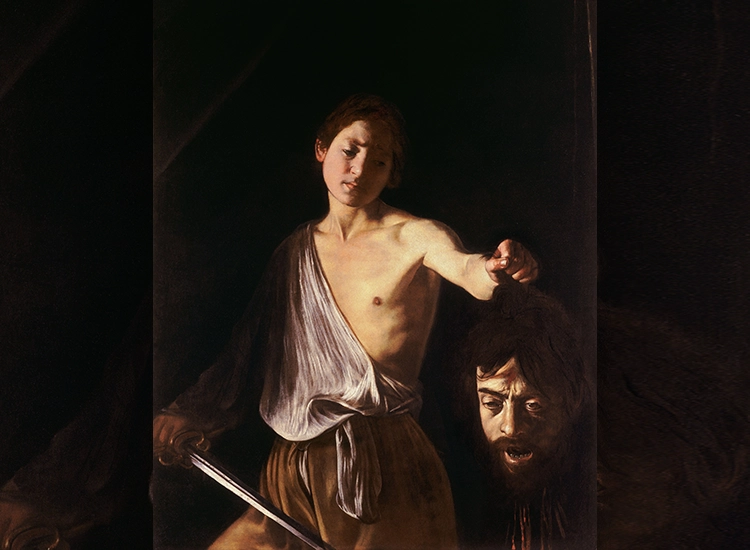
Caravaggio, David with the Head of Goliath (c. 1609–1610)
The young David, the biblical shepherd who defeats the giant Goliath, holds the severed head by the hair. His expression is unusually subdued; his gaze suggests pity or remorse more than triumph. In 1672, Giovanni Pietro Bellori, a seventeenth-century Italian art historian and biographer, identified Goliath’s head as Caravaggio’s self-portrait. The Galleria Borghese also identifies the head as the painter’s likeness. Caravaggio appears as the defeated giant within a biblical narrative, with his image occupying another figure’s role.
Caravaggio fled Rome in 1606 after killing Ranuccio Tomassoni during a violent confrontation. He spent his final years in exile. In that context, the severed head can read as an image of the painter’s own downfall.
The sword bears the inscription “H-AS OS,” which scholars have read as an abbreviation of the Latin motto Humilitas occidit superbiam, or “Humility kills pride.” That reading has fueled a theory that Caravaggio sent the painting to Cardinal Scipione Borghese, a powerful churchman and art collector, as a plea for papal pardon. Some scholars have also proposed that David’s face represents a younger Caravaggio. This would make the painting a double self-portrait. Art historians continue to debate both interpretations.
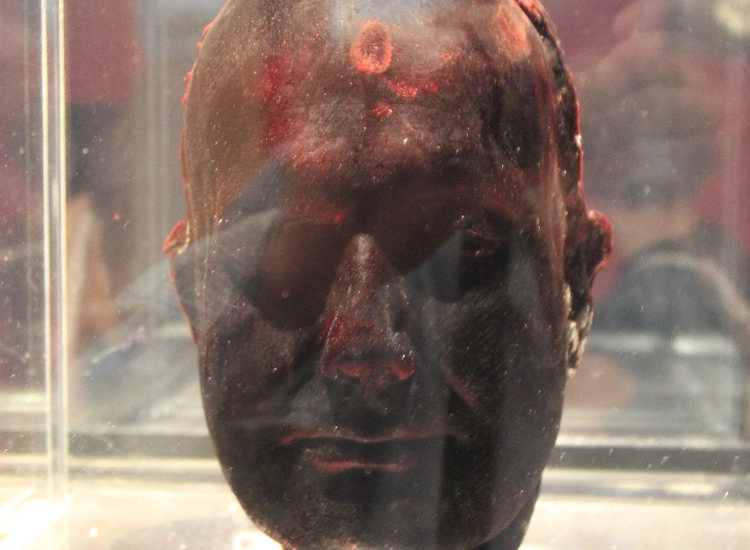
Marc Quinn, Self (1991)
British sculptor Marc Quinn made Self from ten pints of his own blood. A mold taken from his head supplied the form for the life-size sculpture. Quinn made new versions every five years to document changes in his appearance as he aged.
The head sits inside a transparent case and stays frozen with the help of a refrigeration unit. Quinn has described the sculpture as a “frozen moment on life support.”
Stone and bronze portrait busts can preserve a likeness for centuries. Quinn’s portrait depends on blood taken from his own body and a machine that keeps it frozen. The refrigeration system makes the work’s fragility part of the portrait itself.
Short Answers
What are some of the most bizarre self-portraits in art history?
Unusual examples include Ernst Mach’s view from his left eye, Gustave Courbet’s pipe-shaped self-portrait, Hippolyte Bayard’s staged photograph of his own death, and Marc Quinn’s sculpture made from his own blood. Each explores a different way of representing the self.
Does a self-portrait have to show the artist’s face?
No. An artist can represent themselves through a point of view, an object, a staged scene, or a symbolic figure. Some self-portraits challenge the conventions of the genre by changing what represents the artist.
Which artist made a self-portrait from his own blood?
British sculptor Marc Quinn created Self in 1991 from approximately ten pints of his own blood. The life-size head is kept frozen inside a refrigerated case.