Home
 Articles
 Twos Talks
 Videos
The Devil in Art History: The Most Unexpected Depictions
The Devil has a reputation to live up to. In these works, artists put the Devil in situations that sit uneasily with the figure we think we know.

Few figures in art history have been given as many faces as the Devil. From the infernal worlds of Hieronymus Bosch to William Blake’s illustrations for Paradise Lost and the goat-headed figure in Francisco Goya’s Witches’ Sabbath, artists have returned to the Devil across centuries, giving him radically different forms. There has never been a single, fixed image of the Devil. His familiar appearance developed over time through religious texts, folklore, classical mythology, and the imagination of artists. Medieval artists, for instance, borrowed features from pagan gods and other supernatural beings to give form to a figure whose appearance was not precisely established in scripture. Horns or grotesque features alone are not enough to identify a figure as Satan. This selection focuses on the visual arts, from painting and drawing to printmaking and sculpture, and on works that place the Devil in less familiar roles and situations.
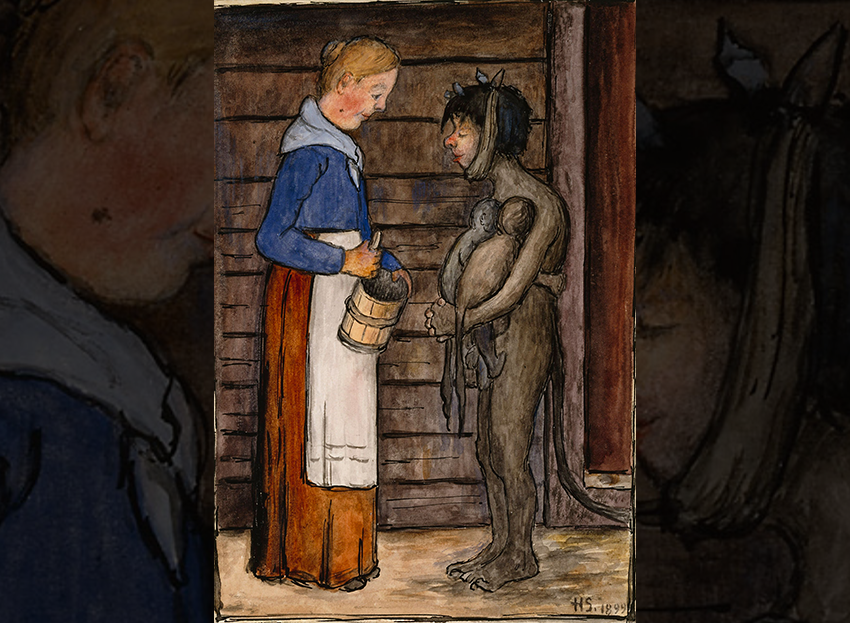
Hugo Simberg, The Farmer’s Wife and Poor Devil, 1899
In Hugo Simberg’s painting, the Devil arrives in a desperate condition. He is small and visibly worn out. Two infant devils cling to him as he stands before a farmer’s wife, who seems to be listening to his plea for help. There is no grand entrance, no threat, and no sign of supernatural power. The Devil appears as a struggling parent in need of support. The woman’s response is equally significant. She looks at him with sympathy instead of fear.
The Finnish artist Hugo Simberg (1873–1917) returned to devils, angels, and figures of Death throughout his career. His supernatural characters often inhabit ordinary settings and behave like humans. In Simberg’s imagined world, the Devil is not necessarily humanity’s enemy. He can be a figure of sympathy, capable of suffering and parental affection. Here, his familiar role as a source of danger gives way to a much smaller predicament. He has a family to care for, and he needs help from someone who should, by conventional religious expectations, regard him as an enemy.
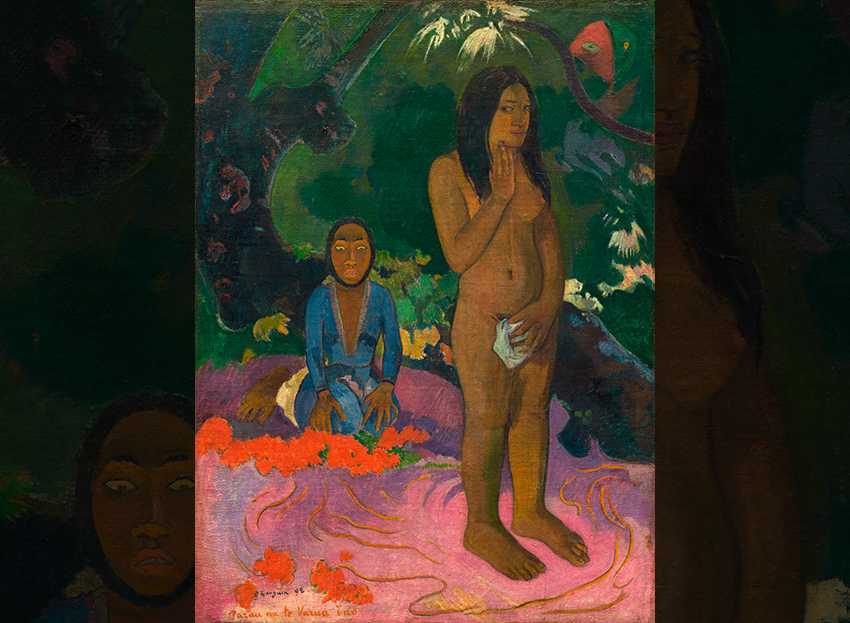
Paul Gauguin, Parau na te Varua ino (Words of the Devil), 1892
Here the Devil takes the form of a masked figure kneeling beneath a tree. He appears behind a nude woman who stands in the foreground, one hand raised to her chin and the other holding a cloth over her body. Her pose recalls traditional images of Eve after the Fall, with a more distant connection to classical depictions of Venus. A strange serpent with a human-like face floats above them. The scene brings together familiar elements of Western religious imagery and a supernatural world that remains difficult to interpret.
The title, inscribed by Gauguin on the canvas, translates as Words of the Devil, though its precise meaning is uncertain. The phrase varua ino refers to an evil spirit or devil, while parau means words. The kneeling figure is therefore identified with the Devil, but the painting leaves us to wonder what he is saying and to whom. Gauguin constructed this imagined Tahitian world from his experiences in the Pacific, accounts by earlier European visitors, and references to Western art and religion. The result is an unusual encounter between the biblical Eve and a spirit from Gauguin’s imagined Tahitian mythology.
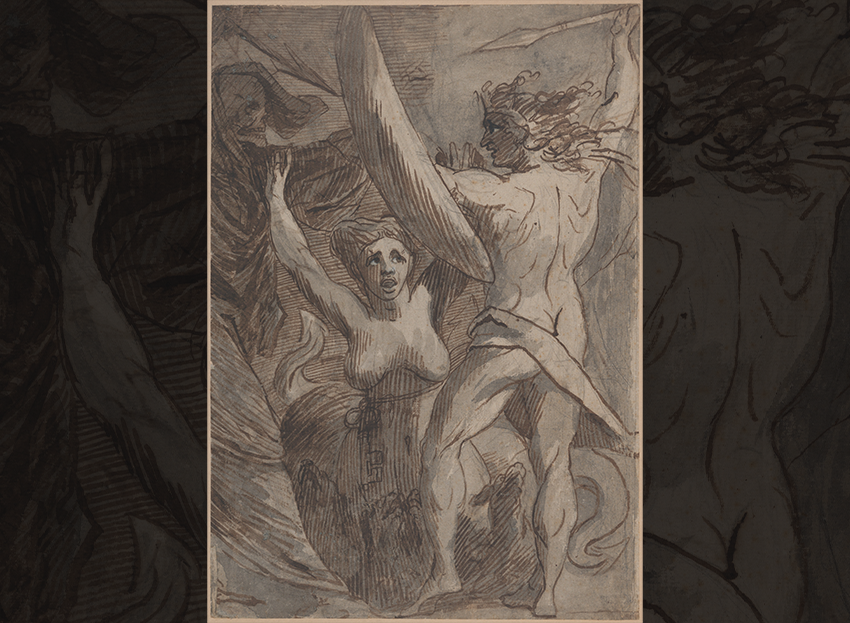
James Barry, Satan, Sin, and Death, 1792–1795
In James Barry’s dramatic interpretation of Paradise Lost, Satan encounters two figures guarding the Gates of Hell. A bare-breasted woman stands at the center, a key to Hell hanging from her hip, while a skeletal figure confronts Satan from the left. This is Sin and Death, two beings whose relationship to Satan makes the scene far stranger than a simple encounter at the gates of the underworld. Sin stands between them as the conflict threatens to turn violent.
The scene comes from Book II of John Milton’s epic poem. Sin is Satan’s daughter, born from his rebellious thoughts in Heaven, while Death is the child of their incestuous union. Satan initially fails to recognize his own son. Barry treats this grotesque family encounter with the scale and physical intensity of classical history painting. His interest in Edmund Burke’s idea of the Sublime is also evident in the imposing figures and atmosphere of terror. The Devil here is both a rebellious figure confronting the forces of Hell and the center of a disturbing family history.
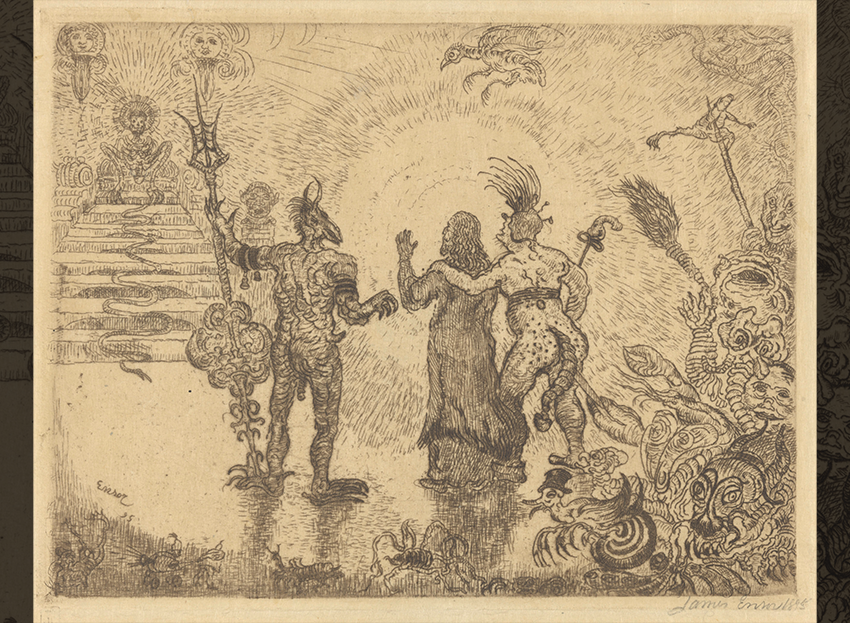
James Ensor, The Devils Dzitts and Hihanox Leading Christ to Hell, 1895
This etching shows two devils named Dzitts and Hihanox leading Christ toward Satan’s throne in Hell. Christ appears to follow them willingly, while grotesque monsters occupy the foreground. The scene draws on the story of Christ’s descent into the underworld after the Crucifixion, an episode in which he visits Limbo to redeem Adam and the righteous. Ensor turns this religious subject into an eccentric procession, populated by fantastical creatures and figures with invented names.
The story comes from apocryphal Christian writings rather than the canonical Gospels. Ensor had already explored the subject in a drawing from 1886, and this 1895 etching presents a simplified version of that earlier composition. Even its elaborate title reflects the artist’s taste for the bizarre. Dzitts and Hihanox sound like characters from an invented mythology, and their role is unexpectedly ceremonial. The Devil’s realm becomes the destination for Christ’s willing descent, with two of its own inhabitants acting as his guides.
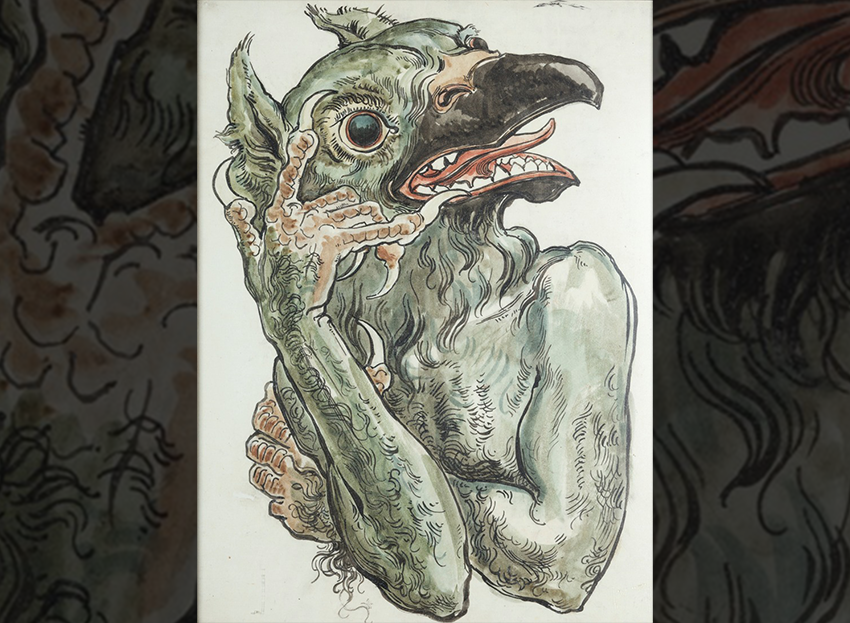
Jan Matejko, Devil with a Bird’s Head, 1890
This devil has a large bird’s beak, sharp teeth, and a grotesquely distorted face. Its clawed fingers frame its head, adding to the creature’s strange, almost comic appearance. Jan Matejko designed the figure as part of a series of decorative motifs for the interior of St. Mary’s Basilica in Kraków. Instead of appearing as a fearsome embodiment of evil, the Devil becomes an eccentric creature among the church’s ornamental designs.
The church’s elaborate decorative program brought religious imagery together with a wide range of ornamental forms. In this setting, the Devil becomes an eccentric figure within the visual language of a sacred interior.
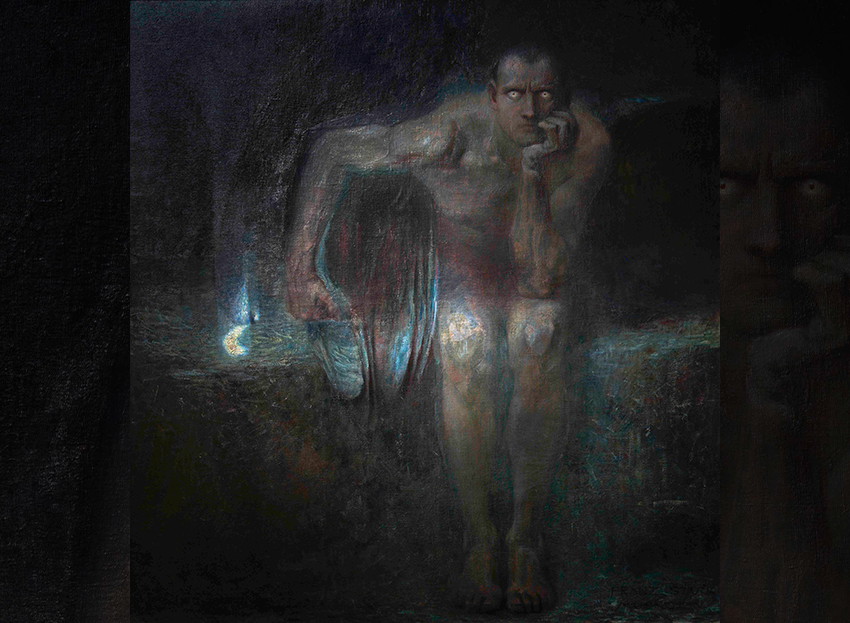
Franz von Stuck, Lucifer, 1890
Franz von Stuck’s Lucifer sits alone in a dark, undefined space. His naked body is folded inward, one hand supporting his head and his wings spread behind him. His wide-open white eyes stare directly at the viewer. There are no flames, torments, or signs of the infernal world. The figure seems absorbed in thought, almost burdened by it. Stuck presents Lucifer as a brooding presence whose expression carries the weight of his fall from Heaven.
The German Symbolist painter created the work in 1890, during a period when artists were increasingly interested in mythology and religious subjects as ways to explore psychological states. The painting was conceived as a companion to The Guardian of Paradise (1889). Stuck later translated Lucifer into an etching, adapting the composition into print. In that version, the figure’s pose has been compared to Auguste Rodin’s The Thinker. Von Stuck’s Lucifer is an unusually introspective image of the Devil, less concerned with the spectacle of damnation than with the consciousness of the fallen angel.
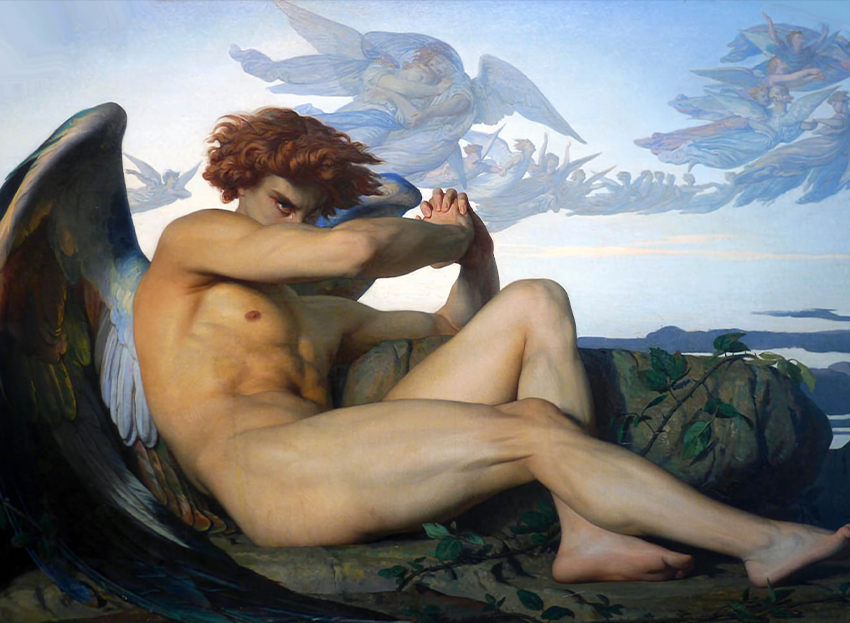
Alexandre Cabanel, The Fallen Angel, 1847
In Alexandre Cabanel’s painting, Lucifer lies on a rocky ledge after his expulsion from Heaven. His enormous wings rest behind him, while his arms cover most of his face. One eye remains visible, fixed in an angry stare. A tear runs down his cheek. High above him, a group of angels moves toward the light, leaving him alone in the darkness below.
Cabanel described the subject in a letter to his patron Alfred Bruyas. He called Satan the principal figure of the painting, once blessed with divine beauty and now broken after daring to rival his creator. The contrast between Lucifer’s fallen state and the radiant angels above him was central to the artist’s idea. The painting gives the Devil an unusually vulnerable expression. His anger is unmistakable, but so is his grief
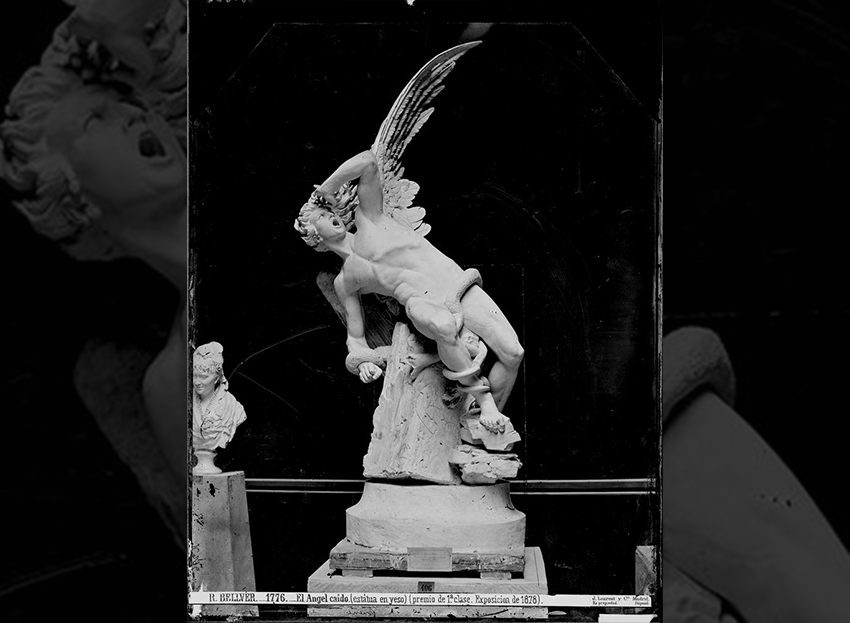
Ricardo Bellver, The Fallen Angel, 1877-1878
A naked angel plunges toward the ground, his body supported by a tree trunk and a serpent coiled around his limbs. His face registers humiliation and terror. This is Lucifer at the moment of his expulsion from Heaven, as imagined by the Spanish sculptor Ricardo Bellver. Inspired by John Milton’s Paradise Lost, Bellver depicts the fallen angel in a moment of intense physical struggle. The tension in the figure’s twisted body recalls the ancient sculpture of Laocoön and His Sons.
Bellver first modelled the sculpture in plaster in Rome in 1877. A bronze version was presented at the 1878 Paris Exposition, where it attracted considerable attention. In 1885, the work was installed in Madrid’s Retiro Park, where it became the centerpiece of a monumental public fountain. The Devil had found an unusual setting. A figure from the Christian story of the Fall now occupied a prominent place in a city park, surrounded by water and everyday public life.
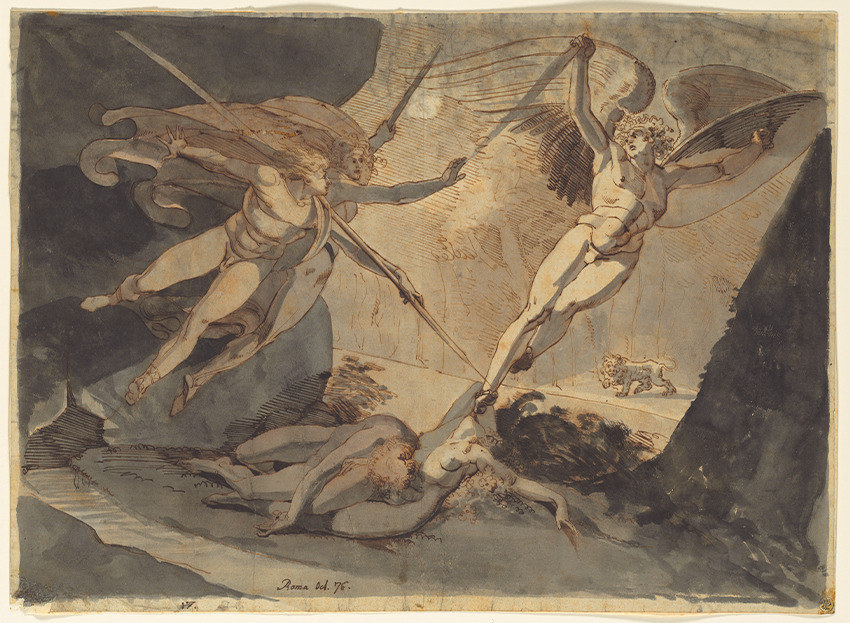
Henry Fuseli, Satan Starts from the Touch of Ithuriel’s Spear, 1776
In this drawing, Satan is disguised as a toad. He has crept into the Garden of Eden and approached Adam and Eve as they sleep. The angel Ithuriel discovers him and touches him with the tip of his spear. Satan is forced to abandon his disguise and resume his true form. Fuseli captures the moment of revelation, with the angel’s raised spear and the figures’ tense movements giving the scene a sudden sense of alarm.
The episode comes from Book IV of John Milton’s Paradise Lost. Satan takes the form of a toad in an attempt to corrupt Eve through her dreams. The disguise is short-lived, since no deception can withstand the touch of a celestial weapon. Fuseli returned to this subject several times, including in a much larger oil painting first exhibited in 1780. This 1776 drawing is one of three closely related versions now held by the Cleveland Museum of Art, the British Museum, and the National Gallery in Stockholm.
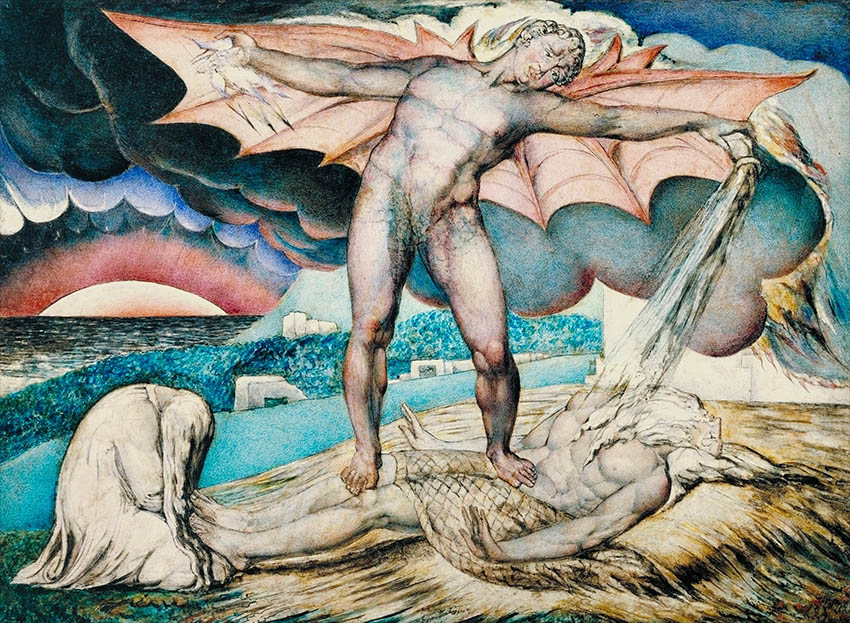
William Blake, Satan Smiting Job with Boils, 1825
In William Blake’s engraving, Satan stands over Job, who has been struck with painful sores from head to foot. The scene comes from the biblical Book of Job, where Satan challenges the sincerity of Job’s faith. He argues that Job remains devoted to God only because his life has been protected from suffering. God allows Satan to test him, with one restriction: his life must be spared.
Blake’s image belongs to a series of twenty-one engravings based on the Book of Job. His interpretation of Satan carries a particular complexity. The figure embodies evil through his cruelty and self-righteousness, but Blake also associates him with rebellion against divine authority. Here, the Devil acts with permission from God, and the suffering of an innocent man becomes the setting for a test of faith. The scene presents a disturbing reversal of the familiar struggle between Heaven and Hell.
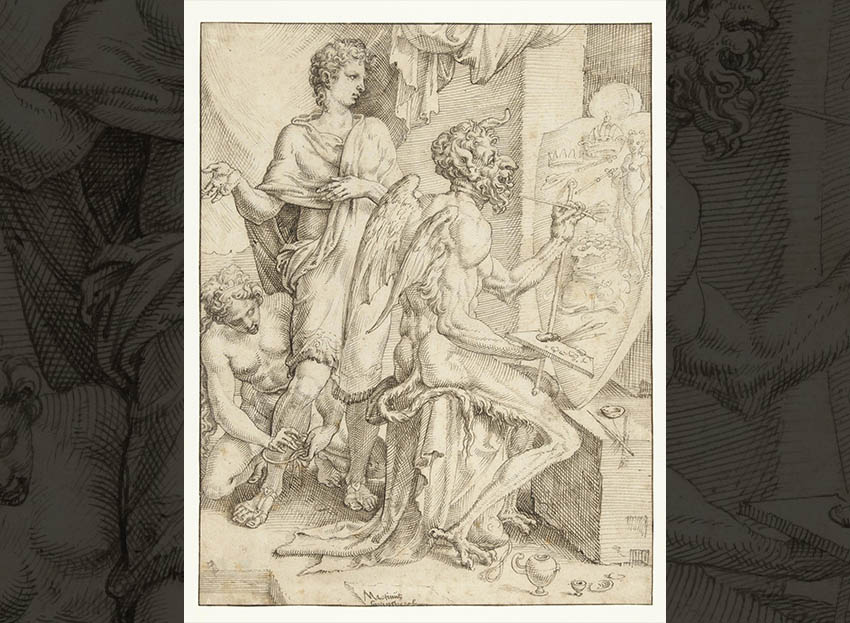
Maarten van Heemskerck, Satan Filling Man’s Heart with Worldly Things, 16th century
In this 16th century engraving, Satan appears as an artist at work. He paints seductive images directly onto a young man’s heart, which serves as his canvas. A naked woman represents sensual pleasure, a collection of crowns and a cardinal’s hat suggest worldly and religious power, and a bag of money stands for wealth. The young man gazes at the image as a woman begins to undress him. Satan’s work is already taking effect.
Here, Maarten van Heemskerck presents Satan as a painter of human desire. The image belongs to a tradition of moral allegories that warned against the temptations of worldly life. The conceit is unusually direct: Satan creates an image inside the human heart, and the viewer watches temptation take shape as a work of art. The Devil is no longer simply the source of temptation; He is its painter.
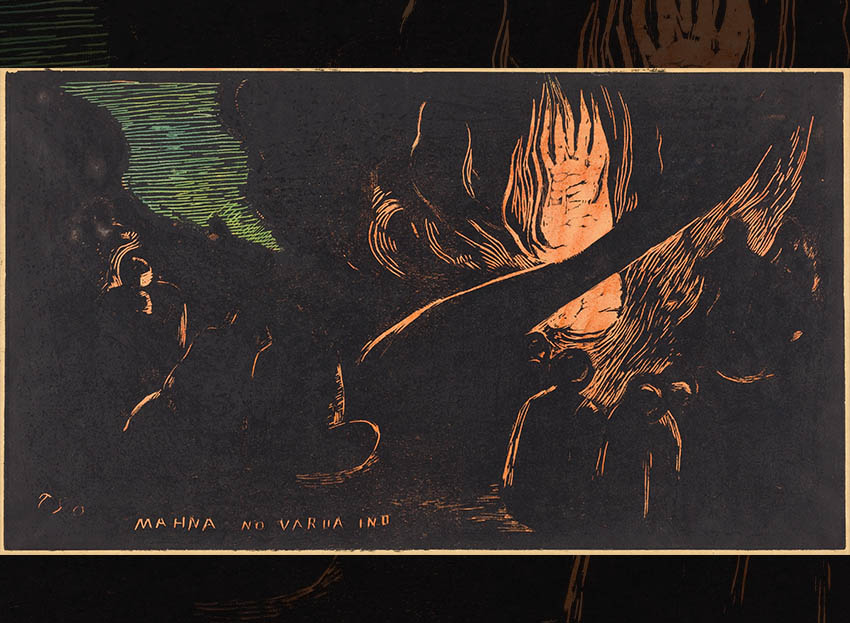
Paul Gauguin, Mahna no Varua Ino (The Devil Speaks), 1894
A group of figures gathers around a fire in this woodcut by Paul Gauguin. The flames burn slightly off-center, while several figures sit or crouch nearby. Their bodies merge with the dark, irregular lines of the surrounding landscape. Beyond them, the composition opens into a dense pattern of trees and foliage. The scene has the atmosphere of a nocturnal gathering, though the identities of the figures and the nature of their encounter remain uncertain. The title introduces the Devil into this mysterious setting.
The print belongs to Noa Noa, a suite of woodcuts Gauguin developed following his return from Tahiti. The prints draw on motifs from Gauguin’s Tahitian paintings, journal sketches, and his own imagination. Rather than offering straightforward illustrations of local customs or mythology, they create a personal vision of the Pacific shaped by both Polynesian and European references. In this print, the gathering around the fire suggests a supernatural encounter, but the precise meaning of the scene remains open.
Gauguin experimented with different inks, colors, and printing methods as he developed the woodcut. The earliest impressions were printed by Louis Roy in 1894, in a small edition of around twenty-five to thirty copies. Gauguin’s son Pola printed and published an edition of 100 impressions in 1921, after the artist’s death. The impressions vary in appearance, but preserve the same composition from the Noa Noa series.
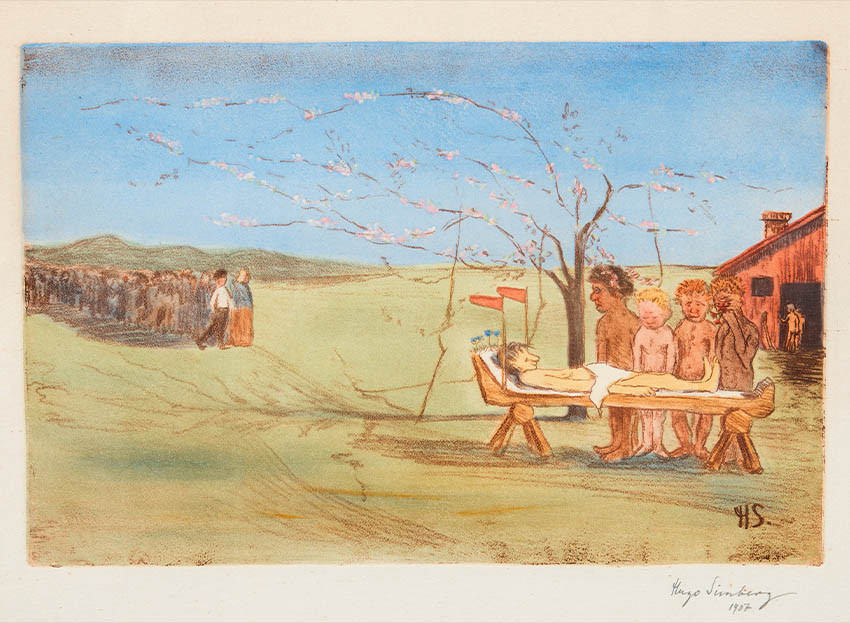
Hugo Simberg, The Devil Is Dead, 1907
In the thirteenth and final work in our selection, the Devil dies. Hugo Simberg imagines the scene as a quiet farewell. A small group stands around his bed, as mourners might gather around someone nearing the end of their life. Their expressions are solemn, and others seem to be approaching to pay their final respects. The Devil is treated almost like one of their own, his passing met with a sense of sadness rather than relief. After centuries of temptation, damnation, and infernal drama, he receives a rather modest farewell.
This scene belongs to the peculiar world Simberg developed throughout his career, where supernatural beings share the everyday world of humans. His devils are often vulnerable and sympathetic figures, and death itself appears as a familiar presence rather than a source of terror. In The Devil Is Dead, these recurring ideas reach an unusual conclusion. Even the Devil, one of art history's most enduring figures of evil, is mourned as a member of the community.
Short Answers (FAQ)
Has the Devil always had a fixed appearance in art?
No. The Devil has taken many forms throughout art history, from fallen angels and monstrous creatures to human-like figures. His visual identity developed through religious texts, folklore, classical mythology, and artistic imagination.
Can the Devil be portrayed as a sympathetic figure in art?
Yes. In Hugo Simberg’s paintings, the Devil appears as a vulnerable figure who struggles with ordinary life and is eventually mourned after his death. These works depart from the familiar image of Satan as an embodiment of evil.
Which artists have depicted the Devil in unexpected ways?
Hugo Simberg portrayed him as a struggling father and a figure mourned after death. Paul Gauguin placed him in an enigmatic Tahitian scene, while James Barry depicted him in a disturbing encounter with his daughter Sin and their son Death.