Home
Home Articles
 Twos Talks
 Videos
First Things First: The First Album Cover in History
A short essay on the origins of the first illustrated music album cover and the moment recorded music acquired a visual identity.

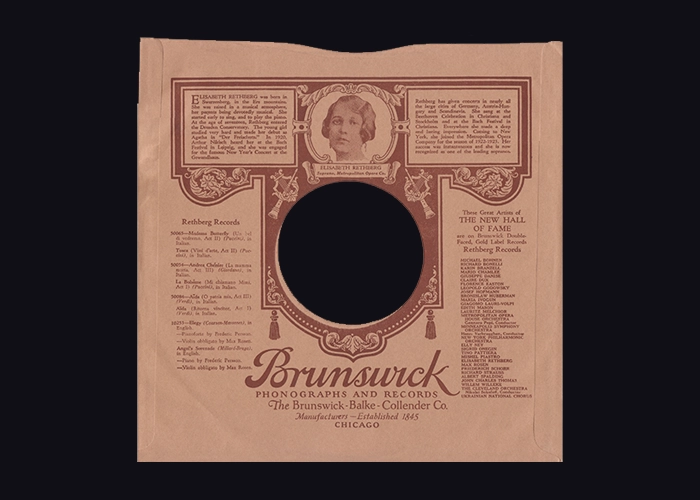
Before album covers became canvases for photography, typography, and cultural mythmaking, recorded music was mostly sold in plain brown sleeves. In the early decades of the twentieth century, records circulated with little visual identity. There was rarely an image to frame the listening experience or suggest the character of the music inside.
The first widely recognized illustrated album cover is credited to Alex Steinweiss, whose work at Columbia Records established the modern album cover as a distinct form of graphic design. After joining Columbia Records in 1939, Steinweiss introduced the idea of individually designed record covers, creating the landmark Smash Song Hits by Rodgers & Hart in 1940. His work transformed the album cover from a functional package into a visual identity for recorded music.
But the story of the first album cover is more complicated than a single date or a single object. Early records were packaged in several different ways, and the idea of the “album cover” itself took time to emerge. This essay explores how that shift happened and why Steinweiss’s design came to occupy such an important place in the history of music and graphic design.
Before the Album Cover
In the early twentieth century, from around 1900 to the late 1930s, the recording industry operated with little interest in visual presentation. Commercial sound recordings were sold primarily as individual 78 rpm shellac discs, placed inside plain paper sleeves that served a protective function. These sleeves displayed basic information such as the record label and catalog number, but they did not function as album artwork or contribute to a broader visual identity.
At the time, the word “album” referred to a bound collection of records packaged together, often in a book-like folder resembling a photo album. These early record albums were designed for storage and organization rather than display. Covers were typically generic, produced by the record company, and visually uniform across releases. What we now understand as the album cover as a designed graphic surface had not yet emerged. Before 1939, there was no established practice of commissioning illustrated covers designed specifically for individual record releases, and no expectation that recorded music would present itself through a distinct visual identity.

Alex Steinweiss
In 1939, a young graphic designer named Alex Steinweiss joined Columbia Records as the label’s first art director. Steinweiss believed that recorded music deserved a stronger visual presence, and he proposed an idea that was unusual for the industry at the time: illustrated covers designed specifically for each release.
His early designs for Columbia Records introduced bold typography, simplified imagery, and references to the performers or musical themes contained in the album. One of the best-known early examples is his cover for Smash Song Hits by Rodgers & Hart, released in 1940, a work often discussed in relation to the first illustrated album cover in history.
By replacing generic packaging with visually distinctive artwork, Steinweiss helped establish the album cover as a designed graphic surface rather than a purely functional container.
The impact was immediate. Columbia Records reported significant increases in sales for albums that featured illustrated covers, reinforcing the idea that visual design could influence how recorded music was perceived and purchased. Through Steinweiss’s work, the album cover began to emerge as a new space for graphic design, where typography, imagery, and music could intersect in a single cultural object.
Selling the Music Visually
Steinweiss’s illustrated covers introduced a new relationship between music and its presentation. For the first time, a record could communicate something about its contents before the needle touched the groove. Through typography, color, and symbolic imagery, album design began to suggest genre, atmosphere, and artistic character at a glance. The surface of the record album gradually became a place where graphic design and recorded sound met.
This development changed how albums circulated in the marketplace. Earlier record sets had been identified mainly through catalog information and performer listings. With the spread of illustrated album covers in the 1940s, visual identity started to accompany the music itself. Designers translated musical themes into images, and record companies began to treat the cover as an integral part of the release. Within a few years, the album cover had established itself as a recognizable field within the broader history of graphic design and music packaging.

Image source: rateyourmusic.com (via People’s Graphic Design Archive)
So, What Was the First Album Cover?
The question seems straightforward, yet the historical record is less tidy than the phrase suggests. If by “album cover” we mean any outer cover used to hold a set of records, then such objects existed well before Alex Steinweiss. Record companies had long issued bound albums and protective folders for multi-disc releases. These were covers in a literal sense, but they were usually generic, minimally designed, and not conceived as distinct visual statements for a particular musical work.
Alex Steinweiss is widely credited with introducing the first illustrated album cover designed specifically for a commercial record release at Columbia Records, with Smash Song Hits by Rodgers & Hart released in 1940. The claim does not rest on the existence of the first outer sleeve as such. It rests on the emergence of the first illustrated album cover widely recognized as part of the music’s identity. From that perspective, Steinweiss’s work at Columbia Records marks a decisive moment. It gave recorded music a graphic surface that audiences could remember, discuss, and desire. For that reason, when historians ask about the first album cover in history, they usually point to Steinweiss, while acknowledging that the answer depends on how the term “album cover” is defined.
Short Answers (FAQ)
Who designed the first album cover in history?
Alex Steinweiss, art director at Columbia Records, is widely credited with creating the first widely recognized illustrated album cover, introduced with Smash Song Hits by Rodgers & Hart in 1940.
What was the first illustrated album cover?
One of the best-known early illustrated album covers was Alex Steinweiss's design for Smash Song Hits by Rodgers & Hart, released by Columbia Records in 1940.
What did album covers look like before Alex Steinweiss?
Before illustrated album covers, records were usually sold in plain sleeves or generic folders designed mainly for protection and storage.