Home
Home Articles
 Twos Talks
 Videos
De Stijl in a Minute: The Art of Asymmetrical Harmony
In the aftermath of World War I, De Stijl artists questioned individualism and sought a new visual order where asymmetry could create balance.

De Stijl began in the Netherlands in 1917 with Theo van Doesburg’s journal of the same name. The movement reduced visual expression to geometric relationships and a restricted color palette in pursuit of a universal sense of order. De Stijl soon reached architecture and design. The same ideas extended into furniture and interiors.
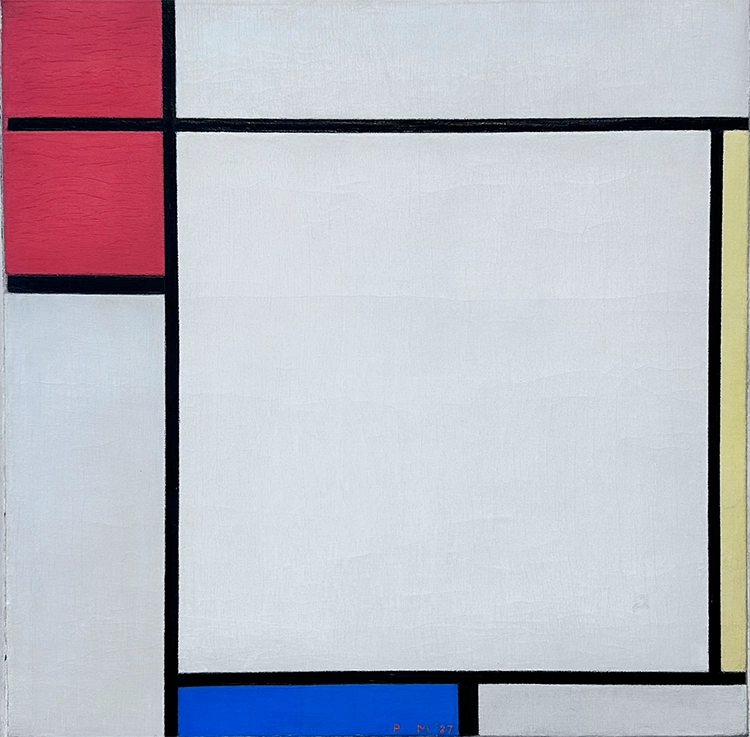
Key Principles of De Stijl
Abolition of Natural Form
De Stijl rejected naturalistic representation in favor of pure abstraction. Artists reduced visible reality to basic relationships between form, line, and color.
Orthogonal Geometry
The movement built compositions from straight horizontal and vertical lines, squares, rectangles, and planes. These elements provided a controlled structure for abstract composition.
Primary Colors and Non-Colors
Red, yellow, and blue formed the dominant palette, paired with black, white, and grey. Limiting color kept attention on relationships between areas and forms.
Asymmetrical Equilibrium
De Stijl sought balance without relying on symmetry. Forms of different sizes and positions could establish equilibrium through their relationships within the composition.
Universal Harmony
De Stijl aimed for a universal visual order that could replace individual expression. The movement connected this ideal to a broader balance between the individual and the universal.
Unity of Art and Life
De Stijl treated art as part of the environment of everyday life. The principles of the movement extended into architecture and design.
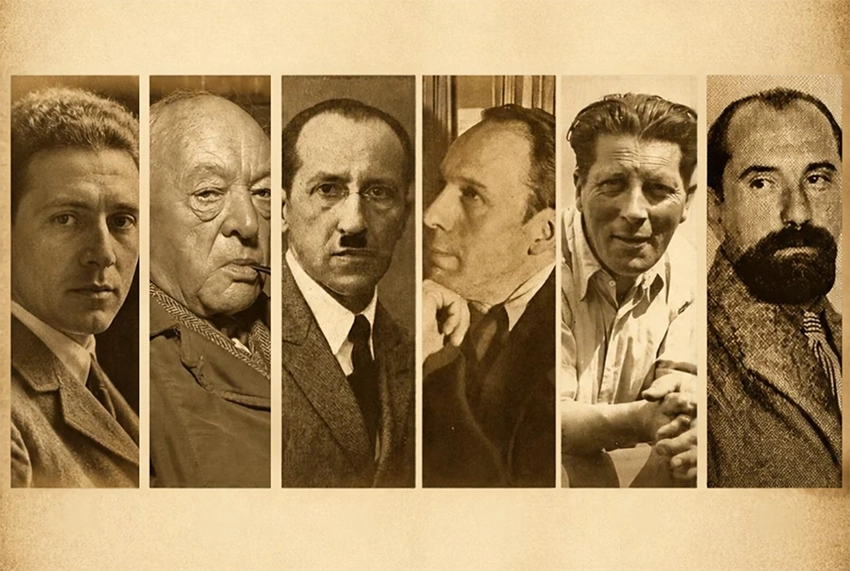
Notable Designers
Piet Mondrian
The face of the movement. Mondrian developed Neo-Plasticism, a systematic formulation of De Stijl’s abstract language. The vertical and horizontal dominated his compositions, with rectangular planes and primary colors arranged in pursuit of universal equilibrium.
Theo van Doesburg
Van Doesburg founded the De Stijl journal in 1917. He was the movement’s leading organizer and theorist. De Stijl principles also informed his work in architecture and design. Later, his use of diagonal lines contributed to a break with Mondrian.
Gerrit Rietveld
De Stijl principles guided Rietveld’s work in furniture and architecture. The Red Blue Chair reduced a functional object to an arrangement of planes and lines. Rietveld’s Schröder House in Utrecht realized the movement’s principles in a flexible domestic interior.
J. J. P. Oud
He explored De Stijl ideas in social housing, particularly in Rotterdam, where he served as municipal housing architect from 1918. Oud designed Café de Unie in 1925. The façade used bold color, geometric composition, and De Stijl-inspired typography.
Bart van der Leck
Van der Leck played an important early role in De Stijl’s move toward abstraction. In 1917, he was the first De Stijl artist to limit his palette to primary colors, black, and white, an approach later adopted by Mondrian.
Vilmos Huszár
An important graphic voice within De Stijl. Huszár designed the typographic ornament for the first issue of the De Stijl journal. Geometric abstraction also defined his work in graphic and interior design.
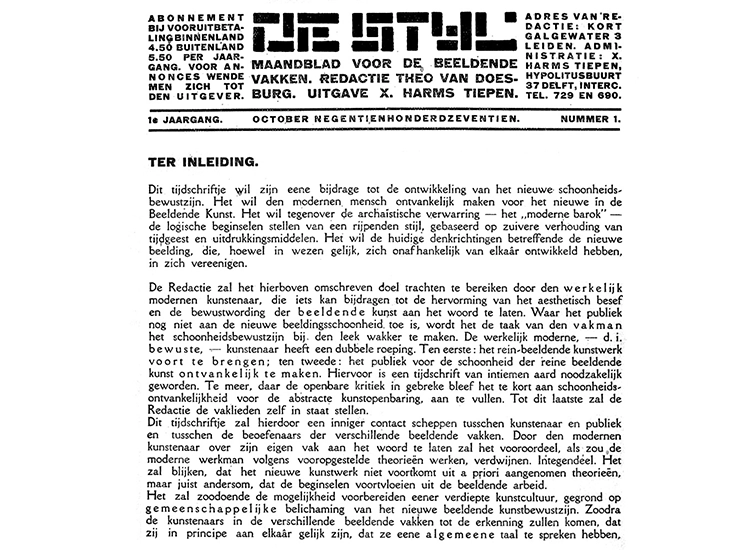
Historical Context and Influences
De Stijl grew from the Dutch avant-garde of the 1910s. Mondrian’s Cubist experiments and his interest in Theosophy informed the movement’s abstract ideals. Dutch architectural rationalism, especially the work of H. P. Berlage, provided a local precedent for its interest in structure and proportion. The First World War formed the wider backdrop, strengthening the artists’ search for a new order after a period of social upheaval. The De Stijl journal connected the group to the wider European avant-garde. Theo van Doesburg maintained close contact with the Bauhaus in the early 1920s.
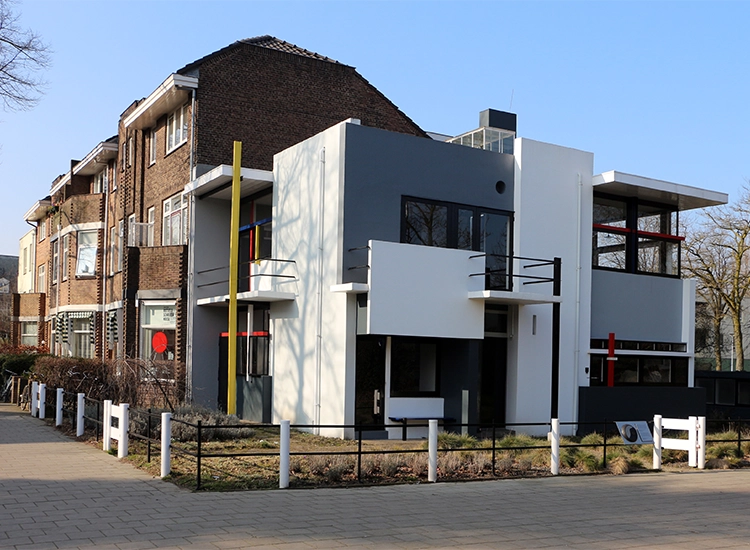
Photo: Sailko, CC BY 3.0
Impact Today
De Stijl still informs architecture and design through geometric structure and asymmetrical composition. The movement also established the idea of a shared visual system that could organize an entire environment. Contemporary designers continue to cite De Stijl directly. In 2019, Dutch collective Experimental Jetset drew on De Stijl and the Café Aubette interiors in Strasbourg for a commission at The Museum of Modern Art.
Short Answers (FAQ)
What is De Stijl in simple terms?
De Stijl was a Dutch art and design movement that sought a universal visual order through pure abstraction, geometric form, and a limited color palette.
What are the main characteristics of De Stijl?
De Stijl is known for horizontal and vertical lines, rectangular forms, primary colors with black and white, and asymmetrical balance.
Who were the key figures of De Stijl?
Key figures included Piet Mondrian, Theo van Doesburg, Gerrit Rietveld, J. J. P. Oud, Bart van der Leck, and Vilmos Huszár.