Home
Home Articles
 Twos Talks
 Videos
Shantell Martin on Finding Your Artistic Style Without Copying Others
From live drawing in Tokyo to global recognition, Shantell Martin explains why artistic identity is not something you find outside, but something you reveal from within.
Editor’s Note:
This article is adapted from our podcast interview with Shantell Martin, originally recorded for Twos Talks and released on the Twos Studio YouTube channel. It has been edited for clarity and format.
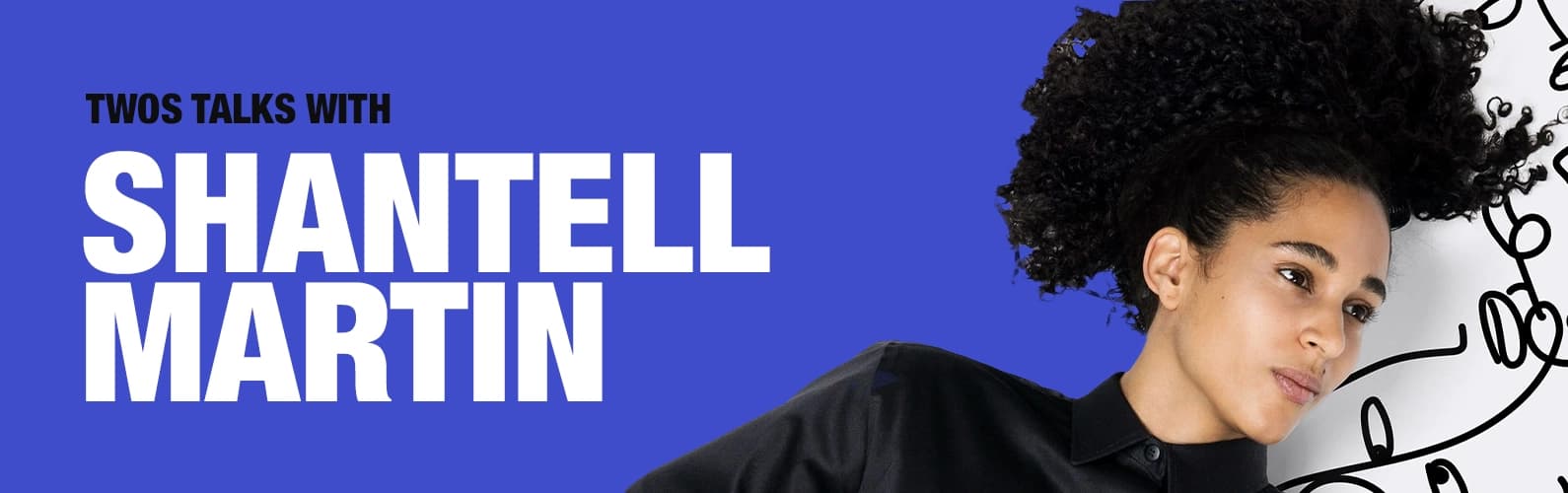
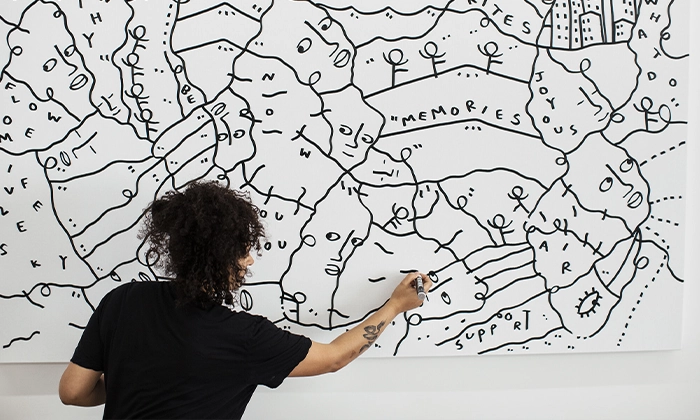
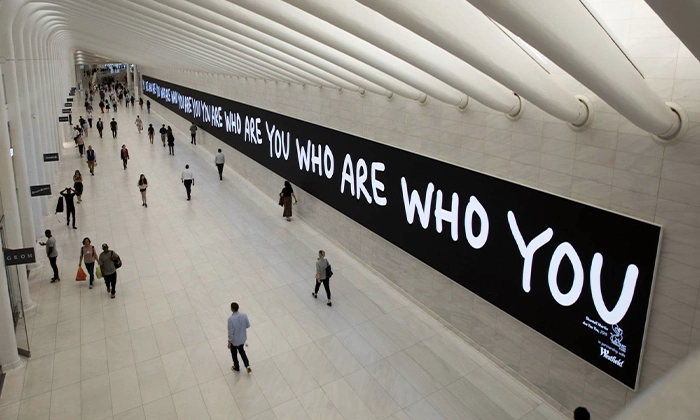
In this episode of Twos Talks, we speak with Shantell Martin, an artist known for her distinctive black and white drawings and live performances that move between art, music, and improvisation. Over the course of her career, Martin has developed a visual language that feels instantly recognizable, yet she describes that identity not as something she designed in advance, but as something that revealed itself over time through repetition, intuition, and experimentation.
Finding Your Style Through Repetition and Intuition
Many artists struggle with the question of how to find their own style, often looking outward for inspiration or direction. For Shantell Martin, that approach is fundamentally flawed.
“I think there’s this illusion that you have to go out and look at what other people have done. Whereas I believe that we can look inside and extract what we look like as an artist from the inside out. And we can do that in a way almost like I stumbled upon in Japan by drawing live, by working stream of consciousness, by being spontaneous, by working intuitively.”
Her process began in Japan, where she was drawing live in clubs alongside music, without planning or overthinking the outcome.
“I wasn’t really planning so much about what I was doing… I would allow myself to follow the music as a prompt to see where the pen would go.”
Through years of doing this, something became clear.
“When I look back at all that work that I did, I can see a core. There’s a recognizable fingerprint to all of the work that I’ve created when I’m not consciously thinking about it.”
For Martin, style is not something you design. It is something you discover by doing the work repeatedly and then observing what naturally appears.
“If I’m going to draw a hundred times and I’m not going to think about what I’m doing, is there certain density? Is there a certain theme? What are those things that reoccur? And then that almost becomes your DNA.”
Confidence Comes From Doing, Not Comparing
In a time where artists are constantly exposed to each other’s work, comparison has become one of the biggest obstacles to developing a personal voice.
“When we have that time to think about things, then we start to think about what someone else might do or what someone else has done. Then we start to compare ourselves.”
For Martin, this kind of thinking interrupts the process.
Instead of focusing on making, artists begin to measure themselves against others, which pulls them away from their own instincts.
“You have to make sure that you’re doing a little bit constantly over a long period of time. And you need to put the work in, because when you put that work in, it feels deserved. And when it’s deserved and the work is there, the confidence is there as well.”
She compares this to learning a physical skill, where progress comes through repetition and patience rather than instant results.
The key is consistency over time, not validation from outside.

Why Changing Your Environment Can Help You Find Yourself
A major turning point in Martin’s career came when she left London and moved to Japan, not because of a specific opportunity, but to remove herself from everything familiar.
“I decided that I want to go somewhere else where no one knows me and I do not know anything about that place so that I can actually really start to figure out who I am.”
Being in a completely new environment allowed her to step outside of expectations, roles, and assumptions that were already defined in her life.
“It’s hard to understand who you are when you have a role… it could be within your friend group, it could be with your family, it could be within society.”
That distance created a kind of blank canvas.
“So moving to Japan gave me that chance to have a fresh start… to approach people, things, situations in a way that felt organic to me and natural to me.”
For Martin, this shift was essential in allowing her identity as an artist to develop without external pressure.
Why You Shouldn’t Rely on Social Media as an Artist
While many artists today build their careers around visibility and platforms, Martin takes a different approach.
“I’m a big post and ghost person. I’ll post and ghost.”
She does not structure her work around algorithms or trends, and she does not prioritize constant engagement.
“I really dislike that there’s algorithms that you need to appease and play to.”
Instead, her focus remains on creating the work itself and building real-world connections.
“I think for the younger folks… it’s about creating that physical community. If you’re making work, find places and spaces to show that work.”
For her, social media is not the foundation of a creative career, but simply one of many tools that may or may not be used.