Home
Home Articles
 Twos Talks
 Videos
Jim Fitzpatrick on Designing One of the Most Iconic Posters in Graphic Design History
From meeting Che Guevara in Ireland to creating one of the most reproduced political images in history, Jim Fitzpatrick reflects on revolutionary graphics, political imagery, and why some designs never disappear.

Editor’s Note:
This article is adapted from our podcast interview with Jim Fitzpatrick, originally recorded for Twos Talks and released on the Twos Studio YouTube channel. It has been edited for clarity and format.
In this episode of Twos Talks, we speak with Jim Fitzpatrick, the Irish artist and designer behind the iconic red and black Che Guevara poster that became one of the most reproduced political images in history. During the conversation, Fitzpatrick reflects on meeting Che Guevara years before designing the famous image, the thinking behind the poster, and why he believed the revolutionary should never disappear from public memory.
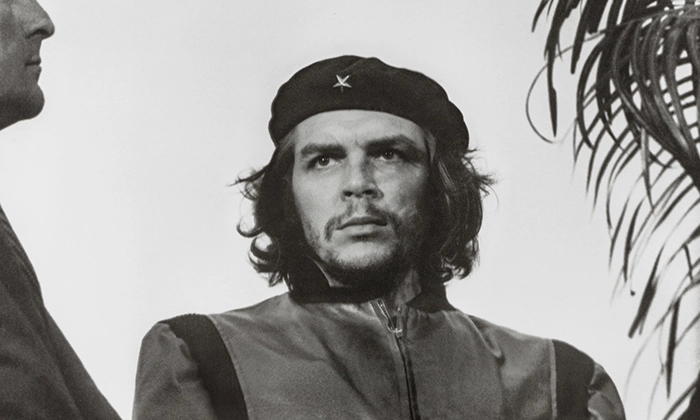
Meeting Che Guevara Before Designing the Famous Poster
Long before creating the famous Che Guevara image, Jim Fitzpatrick unexpectedly met Guevara in person while working at a small pub on the west coast of Ireland as a teenager.
“It is the edge of the Atlantic. Next stop, America. It’s wild. Huge cliffs and massive waves.”
At the time, Fitzpatrick already knew who Guevara was through discussions at school about the Cuban Revolution and anti imperialism in Latin America.
“When I met Che Guevara, I knew exactly who he was. And he was amazed I knew who he was.”
The encounter happened after Guevara’s flight was delayed near Shannon Airport because of heavy fog.
“He had landed at Shannon airport in an Aeroflot flight. The place was fogbound. There were no more flights coming in or out.”
Fitzpatrick still vividly remembers Guevara entering the pub.
“In walk Clint Eastwood and two of his mates.”
Their conversation quickly shifted toward Ireland and Guevara’s Irish ancestry.
“He told me that everything he learned about Ireland, he learned on his grandmother’s knee.”
Although the meeting lasted only a short time, the memory stayed with Fitzpatrick for years.
“That was the conversation. It lasted about ten minutes. Less than that even.”
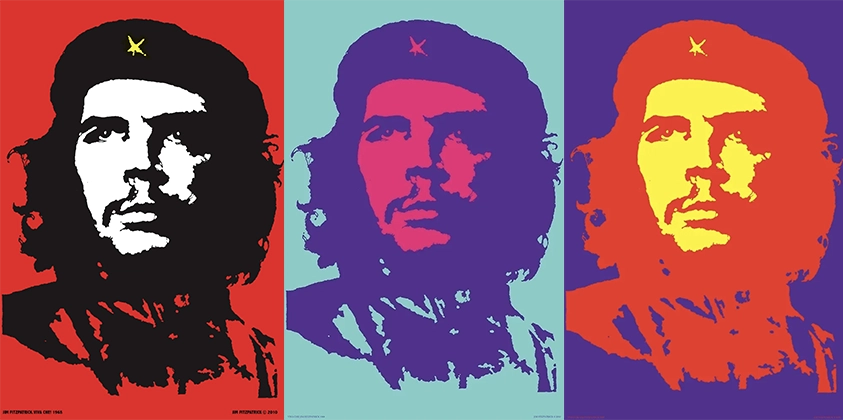
Why Jim Fitzpatrick Created the Che Guevara Poster
After Guevara’s execution in Bolivia in 1967, Fitzpatrick became deeply affected by both the killing itself and the attempts to suppress Guevara’s image afterward.
“I felt so strongly about this person I had met, who I knew as a fighter.”
What angered him most was the way Guevara was executed after capture.
“The way he was killed as a prisoner of war, that really angered me.”
For Fitzpatrick, designing the image became an act of resistance against disappearance.
“I said to myself, he’s not disappearing. Simple as that.”
At the time, Fitzpatrick was already creating political graphics while working in advertising and magazine art direction.
“I thought, I’m going to make a graphic and I’m going to put it everywhere.”
The famous red and black version emerged in 1968 after earlier psychedelic black and white interpretations of the image.
“I wanted it to be in your face.”
Unlike the earlier version, the final poster reduced the image into bold contrast and minimal detail, allowing it to remain recognizable almost anywhere it appeared.
“I always found the black and white one beautiful and psychedelic, but I wanted the new one to confront you immediately.”
Over time, the image spread far beyond its original context through protests, posters, clothing, murals, and reproductions around the world.
“The poster had risen, made its imprint, and then scattered into a thousand different dimensions.”
For Fitzpatrick, the widespread reproduction of the image ultimately fulfilled the exact purpose he originally intended.
“I wanted that image out there and it’s out there.”
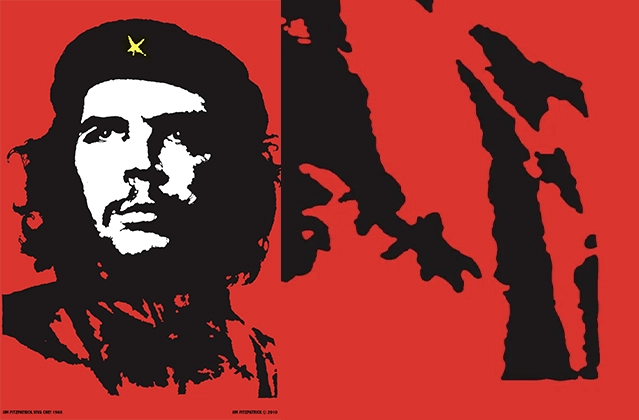
The Hidden Signature Inside the Poster
One of the most fascinating details inside the Che Guevara poster is something most viewers never notice.
Inspired by New Yorker illustrator Al Hirschfeld, who famously hid his daughter’s name inside his drawings, Fitzpatrick secretly embedded his own signature into the artwork.
“I decided that I would put a logo on these images.”
Inside the lower corner of the poster, he concealed the letters “F” and “I” for Fitzpatrick within the folds of Guevara’s tunic.
“You see the F? It’s an F and an I. The first half of an I for Fitzpatrick.”
At the time, the hidden mark felt playful. Years later, it became unexpectedly important as countless reproductions and imitations of the image began circulating globally.
“That hidden logo saved my life.”
Even Andy Warhol’s famous reinterpretation of the Che image accidentally reproduced Fitzpatrick’s hidden mark.
“The best ripoff I’ve ever seen.”
For Fitzpatrick, the experience became a lesson for younger designers and artists about authorship and identity.
“Any designer, any artist should always build something in that they can prove that they did it because you don’t know how important something’s going to be in the future.”
Why Jim Fitzpatrick Never Sold the Rights to the Image
Despite the global popularity of the poster, Fitzpatrick says he never commercially licensed the image.
“I have never once, not once, licensed that image to anybody.”
Eventually, he legally transferred the rights to the Cuban people through the Guevara family.
“I just want to leave it to the Cuban people.”
For him, the artwork was always connected to the political ideals surrounding Guevara’s life and death rather than commercial ownership.
“I don’t care if people are selling it off stands. I don’t care.”
What mattered most to him was that the image survived.
“The fact is I set out when Che was murdered and said publicly that he is not going to disappear.”
Decades later, Fitzpatrick still sees the image less as a product and more as visual memory carried across generations.
“I wanted that image out there. And it’s out there.”